| Home |
|
Part 1 Atomic Structure |
|
Part 2 Simple Bonding Theory |
|
Part 3 Symmetry and Group Theory |
|
Part 4 Molecular Orbital Theory |
|
Part 5 Coordination Chemistry |
Symmetry Operations
Question 1
a. C2
b. C32
c. S3
d. σv
Question 2
a. i
b. σd
c. C32
d. S6
e. C2
Vibrational Spectroscopy
Question 1
a. SiCl4
3N = 15
3N-6 = 9
| Td | E | 8C3 | 3C2 | 6S4 | 6σd |
| Γtotal | 15 | 0 | -1 | -1 | 3 |
Reduces to: A1 + E + T1 + 3T2
| A1 | E | T1 | 3T2 | |
| Translations | (Tx,Ty,Tz) | |||
| Rotations | (Rx,Ry,Rz) | |||
| Vibrations | A1 | E | 2T2 | |
| IR Active | Yes | |||
| Raman Active | Yes | Yes | Yes |
IR = 2T2
Raman = A1 + E + 2T2
b. trans-SF2Cl4
3N = 21
3N-6 = 15
| D4h | E | 2C4 | C2 | 2C2' | 2C2" | i | 2S4 | σh | 2σv | 2σd |
| Γtotal | 21 | 3 | -3 | -3 | -1 | -3 | -1 | 5 | 5 | 3 |
Reduces to: 2A1g + A2g + B1g + B2g + 2Eg + 3A2u + B2u + 4Eu
| 2A1g | A2g | B1g | B2g | 2Eg | 3A2u | B2u | 4Eu | |
| Translations | Tz | (Tx,Ty) | ||||||
| Rotations | Rz | (Rx,Ry) | ||||||
| Vibrations | 2A1g | B1g | B2g | Eg | 2A2u | B2u | 3Eu | |
| IR Active | Yes | Yes | ||||||
| Raman Active | Yes | Yes | Yes | Yes |
IR = 2A2u + 3Eu
Raman = 2A1g + B1g + B2g + Eg
c. SbCl5
3N = 18
3N-6 = 12
| D3h | E | 2C3 | 3C2 | σh | 2S3 | 3σv |
| Γtotal | 18 | 0 | -2 | 4 | -2 | 4 |
Reduces to: 2A1' + A2' + 4E' + 3A2" + 2E"
| 2A1' | A2' | 4E' | 3A2" | 2E" | |
| Translations | (Tx,Ty) | Tz | |||
| Rotations | Rz | (Rx,Ry) | |||
| Vibrations | 2A1' | 3E' | 2A2" | E" | |
| IR Active | Yes | Yes | |||
| Raman Active | Yes | Yes | Yes |
IR = 3E' + 2A2"
Raman = 2A1' + 3E' + E"
d. CH2Cl2
3N = 15
3N-6 = 9
| C2v | E | C2 | σv | σv' |
| Γtotal | 15 | -1 | 3 | 3 |
Reduces to: 5A1 + 2A2 + 4B1 + 4B2
| 5A1 | 2A2 | 4B1 | 4B2 | |
| Translations | Tz | Tx | Ty | |
| Rotations | Rz | Ry | Rx | |
| Vibrations | 4A1 | A2 | 2B1 | 2B2 |
| IR Active | Yes | Yes | Yes | |
| Raman Active | Yes | Yes | Yes | Yes |
IR = 4A1 + 2B1 + 2B2
Raman = 4A1 + A2 + 2B1 + 2B2
Resonance Spectroscopy
Question 1
a. PF6-
19F NMR:
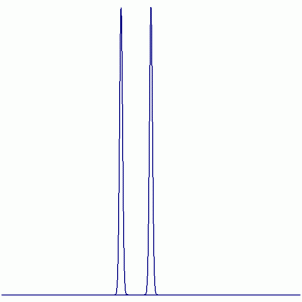
Peak Height Ratio: 1 : 1
Explaination: All F atoms are equivalent (i.e. exchangable by symmetry operations) and couple with one P atom (31P: I = ½, 100% abundant).
b. cis-195PtF2Cl22-
19F NMR:
Peak Height Ratio: 1 : 1
Explaination: Both F atoms are equivalent (i.e. exchangable by symmetry operations) and couple with one Pt atom that is only the Pt-195 isotope (195Pt: I = ½).
c. fac-MoF3(PMe3)3
19F NMR:
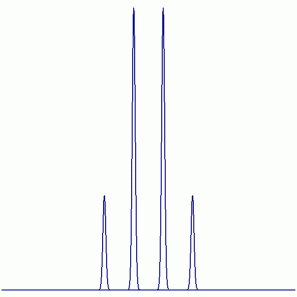
Peak Height Ratio: 1 : 3 : 3 : 1
Explaination: The three F atoms are equivalent (i.e. exchangable by symmetry operations) and couple with the three equivalent P atoms (31P: I = ½, 100% abundant).
d. DF
19F NMR:
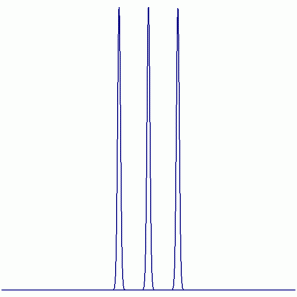
Peak Height Ratio: 1 : 1 : 1
Explaination: The F atom couples with the D atom (D = 2H: I = 1)
e. SiFCl3
19F NMR:
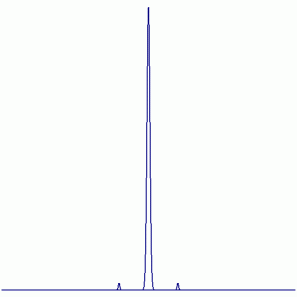
Peak Height Ratio: 2.35 : 95.3 : 2.35
Explaination: The F atom couples with 29Si when present (resulting in satellites 4.7% of the time), the other isotopes of silicon are not NMR active (29Si: I = ½, 4.7% abundant)
f. SeF4
19F NMR:
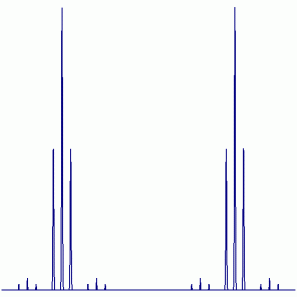
Peak Height Ratio: 3.8 : 7.6 : 3.8 : 92.4 : 184.8 : 92.4 : 3.8 : 7.6 : 3.8
Explaination: The are two unique sets of F atoms. Each set will couple with the Se 7.2% of the time and couple with the other set of two F atoms always (77Se: I = ½, 7.6% abundant; 19F: I = ½, 100% abundant).
g. mer-PF3Cl3-
19F NMR:
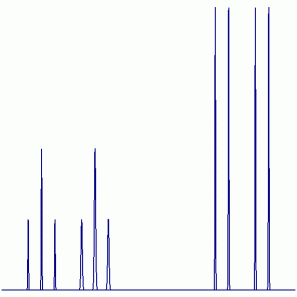
Peak Height Ratio: 1 : 2 : 1 : 1 : 2 : 1 : 4 : 4 : 4 : 4
Explaination: Two of the three F atoms are equivalent (i.e. exchangable by symmetry operations), while the third atom is unique. The F atoms will couple with the P atoms and the non-equivalent F atoms (31P: I = ½, 100% abundant; 19F: I = ½, 100% abundant). The signal for the unique F atom is one the left and the signal for the two equivalent F atoms is on the right.
h. 57FeF4-
19F NMR:
Peak Height Ratio: 1 : 1
Explaination: All F atoms are equivalent (i.e. exchangable by symmetry operations) and couple with one Fe atom that is only the Fe-57 isotope (57Fe: I = ½).
i. AgFPMe3
19F NMR:
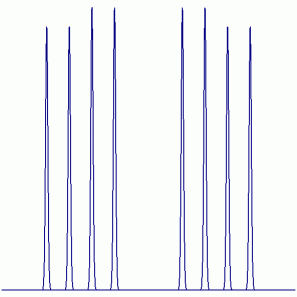
Peak Height Ratio: 24.1 : 24.1 : 25.9 : 25.9 : 25.9 : 25.9 : 24.1 : 24.1
Explaination: The F atom couples to the Ag atom, which has two NMR active isotopes (107Ag: I = ½, 51.8% abundant; 109Ag: I = ½, 48.2% abundant) and then couples with the P atom (31P: I = ½, 100% abundant).
j. AlF4-
19F NMR:
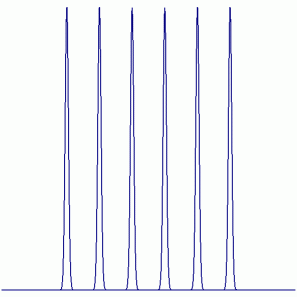
Peak Height Ratio: 1 : 1 : 1 : 1 : 1 : 1
Explaination: All F atoms are equivalent (i.e. exchangable by symmetry operations) and couple with one Al atom (27Al: I = 5/2, 100% abundant).
Question 2
a. SnH4
1H NMR: 5 Peaks (9:8:166:8:9)
b. F2SiH2
1H NMR: 9 Peaks (1:2:1:38:76:38:1:2:1)
c. NH4+
1H NMR: 3 Peaks (1:1:1)
d. cis-PtH2Cl2
1H NMR: 3 Peaks (17:66:17)
e. FPH2
1H NMR: 4 Peaks (1:1:1:1)
f. H3CCH3
1H NMR: 3 Peaks (1:198:1)
g. Cl12CH212CH3
1H NMR: 7 Peaks (1:3:3:1:1:2:1 or 1:2:1:1:3:3:1)
h. H3PSe
1H NMR: 6 Peaks (1:23:1:1:23:1)
i. Cl15NH2
1H NMR: 2 Peaks (1:1)
j. F312CPH2
1H NMR: 8 Peaks (1:3:3:1:1:3:3:1)