

Acadia Experts Help Bird Country Take Flight
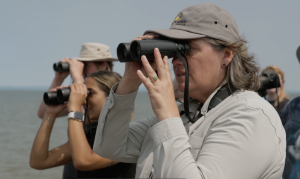
Zoe D’Amato found inspiration for Bird Country during a winter walk in the woods.
“It was quiet, and I realized birdsong is the voice of nature here,” D’Amato says. “If we moved quickly, we could give it a stage.”
Acadia University faculty and students played major parts on that stage to help make the vision a reality.
D’Amato and Tracy Bennett, who recently produced a 36-episode series called Wild Nova Scotia together, wanted to explore Nova Scotia’s birds in more depth.
“Birds are a gateway,” D’Amato says. “To enjoy them, you have to be in nature and be present. Then you want to protect it.”
“It was a lightning bolt moment. Tracy’s an avid birder, and I learned a lot filming Wild Nova Scotia. It felt like the perfect, meaningful project. Within weeks, we were ready to go.”
The result was Bird Country, a new documentary screening in Wolfville at 7 pm on April 1 at the Al Whittle Theatre as part of the ACC Film Series.
Inspiring Care Through Storytelling
In the face of so much difficult ecological news, D’Amato and Bennett set out to tell an inspiring and uplifting story about birds.
“We focus on helping people fall in love with one small piece of the ecosystem,” Bennett shares. “If people start to care about it, they’ll want to protect it.”
They faced several challenges making Bird Country—most notably, wildfire restrictions and the difficulty of filming birds.
“We had to rewrite about five different story elements because we weren’t allowed in the forest,” Bennett notes. “It was a tricky time to produce a nature documentary.”
There was also the difficulty of getting a “bird in the hand.”
“Birds in the wild are terrible at sitting still for their close-ups,” D’Amato says. “Tracy’s connections introduced us to scientists whose work brought them physically close to birds. That meant we could offer an intimate glimpse into lives most people will never witness first-hand.”
Many of the researchers who offered this up-close look into the life of birds came from Acadia University. When asked why, Bennett says it was because of the university’s focus on nature education.
“Acadia excels in nature education,” she says. “Many top bird biologists in Nova Scotia came through Acadia.”
Acadia Researchers Take Front and Centre
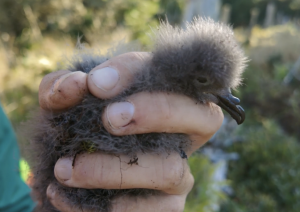
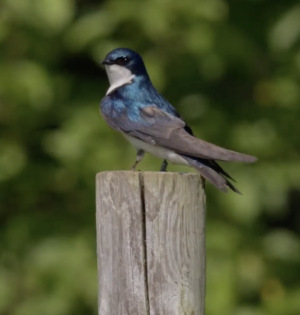
Acadia research stories frame Bird Country, grounding it in local expertise. It begins with Professor Emeritus Dave Shutler’s (Biology) decades-long research on tree swallows nesting near Wolfville. The film concludes with recent Acadia Master’s grad Linda Hutchinson’s (’26) work on how light and mercury affect the Leach’s storm-petrel.
Hutchinson studied storm-petrels, a threatened bird species, on Acadia’s Bon Portage Island—home to the province’s largest storm-petrel colony.
Her research examined how different wavelengths of light affect birds’ navigation. When they leave the colony, storm-petrels are attracted to coastal lights, causing them to fly towards and land in populated areas instead of towards the ocean—a phenomenon called “stranding.”
“They can get stranded on docks or roads,” Hutchinson explains. “They often get hit by cars or eaten by predators because they’re disoriented.”
She adds that storm petrels have unusually high mercury levels compared to other birds in the same environments. Researchers are still studying how this heavy metal affects the birds.
While Hutchinson’s Master’s research focused on adult birds, in Bird Country, she and a group of Acadia undergrads conducted an experiment to examine how different light colours affect juvenile storm-petrels as part of the film.
“We placed juveniles in a box with two arms, each with a different colour of light. We observed which direction they chose,” she says. “There’s some really cool footage of the cameras going through the experiment box. They did a great job of explaining it in the film.”
They focused on juveniles in the experiment because they’re most likely to get stranded, so understanding their preferences has the most conservation impact.
Tracking Birds, Connecting Worlds
Hutchinson will join a panel of experts after the Bird Country premiere at the Al Whittle Theatre to answer audience questions. Also on that panel will be Lucas Berrigan (’18), another Acadia Master’s grad who did his thesis on the Swainson’s Thrush.
“It’s a common, but often unseen bird in Nova Scotia,” Berrigan says. “It has a beautiful, ethereal song.”
Berrigan’s Master’s research involved tagging the birds with radio transmitters to understand how they navigate their annual migration to South America. That led him to work with Motus. Motus, part of Birds Canada, is an international network tracking the movement of birds, bats, and insects using tags and receiving stations. The resulting data aids conservation efforts.
As Motus’s Manager of Technology and Web Development, Berrigan blends his biology background with a lifelong passion for technology. In the film, D’Amato and Bennett follow Berrigan as the Motus team installs tracking stations and tags birds in Labrador and New Brunswick.
Collective contributions to celebrating conservation
The film also features Acadia students Alina Rutherford, Silver Marshall, Laine Mosley, Catherine Potvin, Gretchen McPhail, and Caleb Gibbons. Rounding out Acadia’s contribution is Professor of Music Nicholas D’Amato—Zoe’s husband—who composed the film’s theme music.
The co-producers say they’re both nervous and excited for the premiere.
“It feels like an important time to celebrate conservation,” Zoe D’Amato says. “I hope the film feels uplifting and gives people a sense of hope and agency.”
“It’s about reminding people that we don’t just live in towns with businesses and cars,” Bennett adds, “We live on a planet with a fragile system we’re all part of. It’s time to wake up and see what we have to lose.”
D’Amato adds that the film also gives scientists a platform.
“They’re heroes in their own way,” she says. “They’re in the mud doing the critical work. If more people understood what they do, there’d be much more support for it.”
Bird Country is produced by Firefly Digital Media in association with Eastlink Community TV and supported by the Nova Scotia Film and Television Incentive Fund and Canada.