

Acadia is Recognized for being WISE
 “We know that belonging, representation, and early encouragement matter enormously in shaping whether young women see science as a place where they belong,” says Dr. Randy Newman, chair of Acadia’s Department of Psychology,
Dr. Newman is also the co-chair of WISE (Women in Science and Engineering) Acadia alongside Dr. Melanie Coombs (Biology). The initiative supports women and girls in science and engineering while also fostering institutional and cultural change within STEM environments.
“WISE Acadia is best described as a community of practice, rather than a single program, which includes coordinated initiatives, formal programming, and informal mentorship structures,” explains Dr. Newman.
When the initiative began in 2014, it emerged from collaboration among faculty in science and women’s and gender studies at a time when women-identifying faculty were significantly underrepresented. At that time, only 22 per cent of the Faculty of Pure and Applied Science were women-identifying, with some units having no women faculty at all.
WISE functioned as an informal support and mentorship space for women faculty navigating academic careers in male-dominated environments. Over time, Dr. Newman says it evolved into a more formalized structure that includes student programming, outreach, and community engagement.
It was the idea of mentorship and peer support that sparked Drs. Newman and Coombs’ interest in WISE. They saw it as an opportunity for current and prospective students to learn and grow.
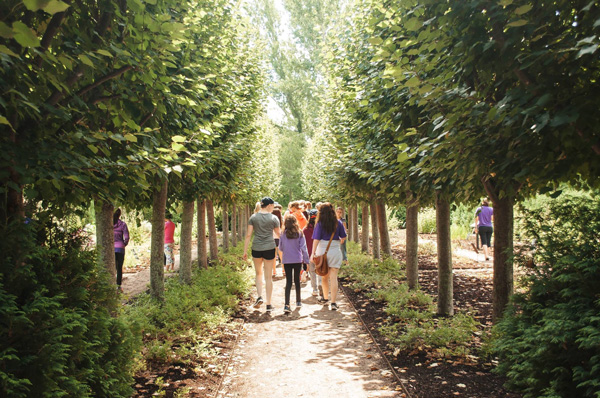
There is an affiliated WISE student group that hosts events throughout the semester and welcomes students who are curious about STEM, mentorship, or equity work. Students also serve as mentors in youth camps and outreach programs, help design and deliver workshops for high school students, and gain leadership experience through layered mentorship models.
This structure allows students to move from participants, to mentors, to leaders, Dr. Coombs says. Because the barriers women face in STEM are structural and cultural rather than related to ability, mentorship is key to overcoming them. A strong mentor can help young women entering the field encounter isolation, imposter syndrome, and attrition, particularly at key transition points.
“Mentoring matters because it builds confidence and identity for younger students, reinforces learning and leadership skills for mentors, and creates continuity across generations of scientists.”
The work and focus of WISE Acadia and organizations like it are paying off. Although Dr. Newman says the results are largely anecdotal, her strong impression is that Acadia has hired more women-identifying faculty across science disciplines, and that there is greater representation of women at senior ranks, including full professor, a trend that aligns with what is seen nationally.
At the student level, several current students have shared that participating in WISE camps or retreats positively shaped their impression of Acadia and influenced their decision to attend the university. These patterns show the importance of WISE’s long-term impact on recruitment, retention, and sense of belonging, she says.
Dr. Coombs says she is so proud that WISE has endured and grown. What began as an informal support network at a time when women faculty were isolated, today is a sustainable, intergenerational community of practice that supports faculty, empowers students, and reaches youth in our Valley communities.
“That continuity, people staying, returning, mentoring, and building something larger than themselves, is deeply meaningful,” she says. “WISE Acadia really showcases what is possible when mentorship, community, and intentional design come together.”
The important work WISE Acadia is doing is not going unnoticed.
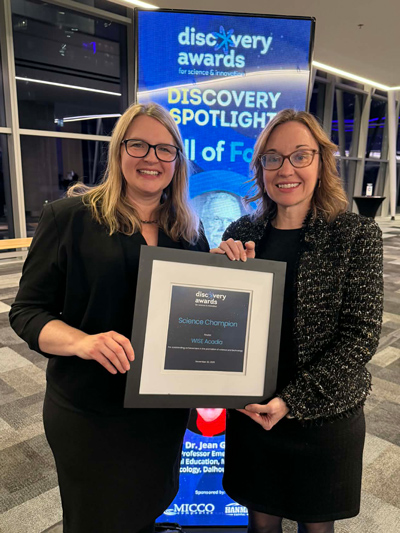
 Last fall, WISE Acadia was recognized as a finalist in Nova Scotia’s Discovery Awards science champion category. The award recognizes an individual, organization, or program that promotes science and technology education and STEM careers, and through their work helps the public better understand science.Nominees also serve as role models, particularly for youth, in support of the development of a science and innovation-oriented culture in the province.
This is exactly what WISE Acadia aims to do, which is why Drs. Newman and Coombs say it was such an honour to be recognized.
“The nomination acknowledged WISE’s role in making science accessible, particularly in our rural environment, and for our high-quality programming and innovative pedagogy,” says Dr. Newman, noting how their women in science course was the first of its kind in Canada and continues to be a high demand course for Acadia students.
They point out that WISE has been largely sustained through volunteer labour. While they have received support in the past from a generous WISE alumna to help sustain the camp, much of the programming continues to rely on the time and commitment of faculty, students, and community partners. As costs continue to rise, long-term sustainability is an ongoing concern, WISE welcomes broader involvement, partnerships, and support to ensure this work can continue and grow.
And by doing so, they will be creating the next generation of WISE women.
Get the Acadia experience
Learn more about Women In Science and Engineering at Acadia University.