

Acadia researchers revamp free AI literacy course
To paraphrase Ferris Bueller, technology moves pretty fast. If you don't stop to learn about it once in a while, you could miss what it’s doing to your brain, and the world.
It seems like every day there’s a new AI feature or platform being trotted out, and willingly or not, people are using it. But does the public really know what AI is, how it works, and its effects?
Dr. Lauren Wilson Finniss (Vice-Provost, Curriculum and Planning) says that as a university, it’s Acadia’s responsibility to “help students become thoughtful and responsible users of AI, while ensuring they are still engaging deeply in the learning that is at the heart of their education.”
Enter Dr. Daniel Lametti (Psychology), and the AI literacy course. The initial audience was Acadia students with the intention of helping them navigate use of the technology thoughtfully and responsibly, making informed decisions about if they’d use it, and if so, when.
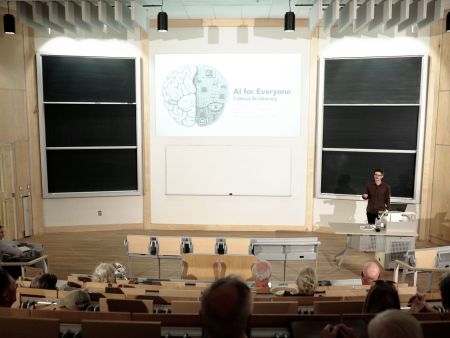
In 2024, Dr. Lametti gave the first AI literacy lecture to a packed auditorium of first-year students. When he informally polled the room about who had used AI, roughly one-quarter raised their hands.
A year later, it was about three-quarters.
This August, it was everyone.
Moving at the speed of technology
The speed of that change prompted Dr. Lametti and Dr. Wilson Finniss's team in the Office of Curriculum and Planning to expand the course, offering it up for free to the general public. Anyone, anywhere in the world who wanted to learn about AI was granted access to the course.
Dr. Wilson Finniss says it was a natural extension of Acadia’s responsibility to its students to open the course up to the general public.
Just two weeks after releasing the course to the public in February of 2026, it already had over 5,000 enrollments.
The people who signed up also challenged Drs. Lametti and Wilson Finniss’ assumptions about who needs AI education. The median participant was 54, with learners ranging from their 20s to their 90s. They came from every province and territory in Canada and more than 60 countries.
Most importantly, more than 90 per cent of learners said that they had never received AI literacy training before.
They weren't necessarily new to AI. They were new to being taught about it.
Since then, interest in the course continued to grow. But so did the technology; rapidly developing tech requires likewise rapidly evolving education about it. And so, this fall Acadia is releasing the second iteration of the class.
AI literacy 2.0
The updated version of the course, titled “AI for Everyone: Critical AI Literacy,” keeps many of the same components and offers the same grounding principle: the key to responsible use is understanding how AI works and the detrimental effects it has.
Through a short lecture, podcast and interactive activities, participants explore how AI works, why it sometimes gets things wrong, and issues including data privacy, bias, energy use, cognitive debt and the impact of AI on human thinking.
The course has been updated based on what Acadia learned from the thousands of participants in its first public offering. The goal isn't to tell people whether AI is good or bad. It's to give them the knowledge to make more informed decisions about when and how to use it.
Like 1.0, this course requires no previous experience with AI or any technical skills. It doesn't promise to turn participants into AI experts, but it does answer questions like:
- How do large language models like ChatGPT actually work?
- Why do they sometimes confidently provide information that isn't true?
- What happens to privacy when information is entered into an AI system?
- What are the potential effects of AI on critical thinking?
- And when does using AI help us, who is really thinking when we use AI?
The question that most participants were looking for an answer to, though, is "What happens to our ability to think when increasingly capable AI tools can do more of the thinking for us?"
The course explores this question through the concept of cognitive debt. Which, when asked as part of the exit survey, was one of the concepts that resonated most strongly with learners. More than 80 per cent of participants identified the potential impact of AI on critical thinking as a concern.
The point isn’t that using AI inevitably makes people think less. It’s that understanding what we are giving up when we use AI gives people a better chance of deciding when AI is helping them vs. when doing some of the harder thinking themselves may be precisely the point.
So, is it working?
The resounding public response has demonstrated that a short course can have an impact. Of the more than 2,000 learners who completed the original offering, 90% rated it as useful or very useful, and 79% said it changed their views on AI. Early results from the newly redesigned course are already demonstrating similar findings.
Bringing the course to the public has been a satisfying undertaking for the people leading it.
Dr. Wilson Finniss says that the most rewarding part of opening up the course to the public has been reading the comments and reflections from learners.
“You can see the learning happening,” she says. “People are questioning assumptions, reconsidering how they use AI and thinking more carefully about the role they want it to play in their lives."
"What began as something simple, sharing a course we had already developed for our students with the public, has reinforced how important it is for universities to contribute what we are learning to the broader conversation about AI literacy.”