

Active, ‘for Life’: Not Just a Fitness Program
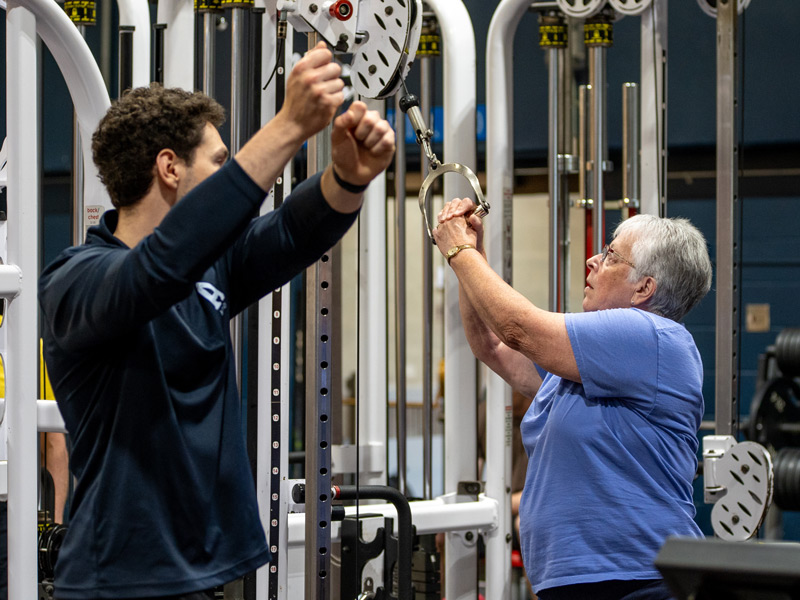
Active for Life keeps older adults independent and connected, while easing pressure on hospitals, nursing homes, and emergency rooms — a five-year pilot has proven the case for making it permanent.
As Sandra Ross approaches her 80th birthday, she’s doing things she once worried might become impossible.
Three years ago, her balance was so poor she could stand on one foot for only about five seconds. Today, she holds that position for 45. She hikes, walks easily with her grandchildren, and feels stronger than she has in years. “I seem to be aging backward,” she says.
Sandra is one of hundreds of older adults across the Annapolis Valley who participate in Active for Life (AFL), a community-based exercise program delivered by Acadia University’s Centre of Lifestyle Studies. Designed for people managing chronic conditions, mobility limitations, and the realities of aging, AFL helps participants build strength, balance, and confidence in a safe, supportive environment.
But ask participants what keeps them coming back, and the answer is rarely a fitness metric. It’s the people. The routine. The sense of belonging. And, for most, the growing conviction that this program is the reason they’re still living independently.
“I am sure the benefits of the program are helping to keep me living in my own home and out of the hospital and nursing home.”
— Sandra Ross, 79
Where it started
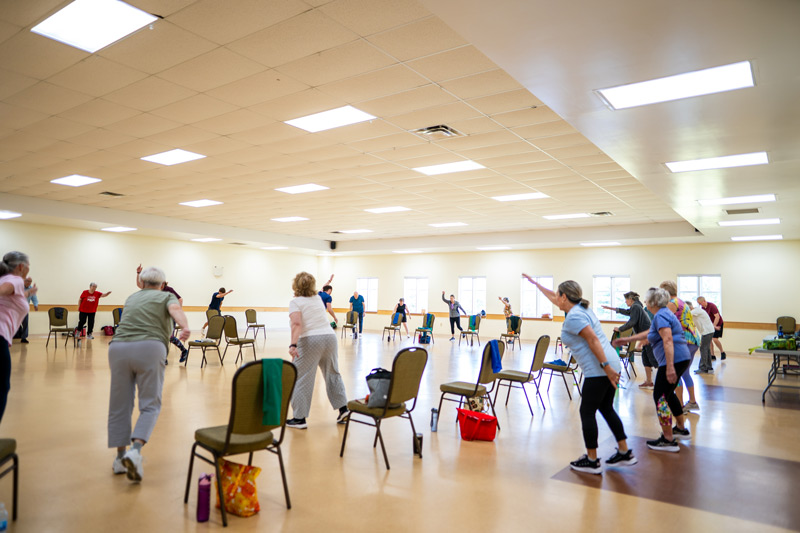
Active for Life began in 2016, emerging from an innovative approach incorporated by Dr. Jonathon Fowles, the Director of Acadia’s Centre of Lifestyle Studies and Health and Wellness Institute, and Professor in the School of Kinesiology. His work focused on embedding exercise specialists in primary care clinics alongside physicians and dietitians. What quickly became clear was that many patients needed somewhere to go after receiving advice from doctors that they needed to move more.
“Most participants have a medical condition plus a physical limitation that makes it challenging to know what to do for exercise,” says Dr. Fowles. “Clinical Exercise Physiologists deliver an evidence-based program, and then individualise it to properly address and accommodate for that person’s needs.”
It’s easy to oversimplify a solution. “Just go for a walk” is common advice — and unhelpful, if you’re alone, in pain, prone to dizziness, and afraid of falling. A Clinical Exercise Physiologist (CEP) is a kinesiology graduate with specialized training in exercise for individuals with medical conditions. The CEP starts this healthcare journey with building basic balance and strength, helping a person feel steady on their feet, and creating a safe space to regain confidence before anything else.
Today AFL serves participants in Wolfville, Kentville, Berwick, Canning, New Minas, and Port Williams, as well as virtually. The 12-week program is available for $75 for participants, though those who can’t afford it can easily apply to attend for free. Before each session, instructors complete screening and functional assessments, so they know who is recovering from surgery, managing heart disease, or needs modifications. Acadia kinesiology students in training gain hands-on skills supporting participants — making AFL an experiential learning opportunity as well as a community resource.
What it does
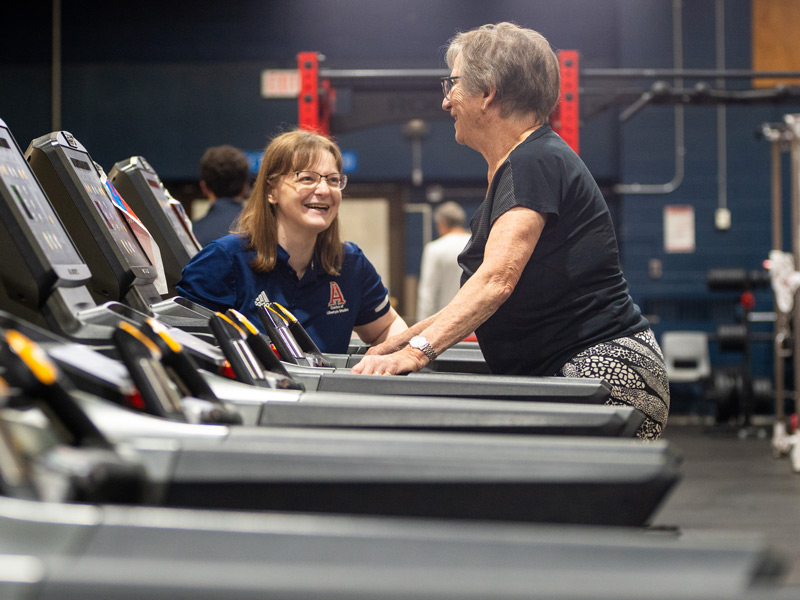
A typical class includes mobility, balance, strength, cardiovascular, and flexibility training. The outcomes are well documented: since 2020, more than 3,000 participant registrations have been recorded across the Valley’s six communities. A five-year outcomes report by Dr. Fowles and doctoral student Brianna Smith (formerly Leadbetter) found that after a single 12-week program, participants improved across every measure of physical function. Over two years of consistent participation, aerobic fitness increased 21 per cent, lower-body strength improved 25 per cent, and three-quarters reduced their frailty score by a full category.
For Carol Blair, who has had both knees and both hips replaced, the proof is in something specific and hard-won: “I was told that I would have to walk up and down stairs one step, one foot at a time. But the program has given me the strength and confidence to be able to walk up and down stairs like a normal person. This no doubt sounds trivial to some, but as a woman who will be celebrating her 80th birthday this year, it makes me very happy.”
Family physician Dr. Drea Mossman of Mud Creek Medical Co-op in New Minas sees the difference in her patients. “Fitness programs targeting vulnerable populations are a relatively inexpensive and high-impact preventive health tool,” she says.
Cost effectiveness evaluations of the AFL program indicate that every dollar invested in the program generates an estimated $1.50 to $3 in avoided healthcare costs — through fewer falls, reduced emergency visits, and delayed long-term care.
More than a fitness program
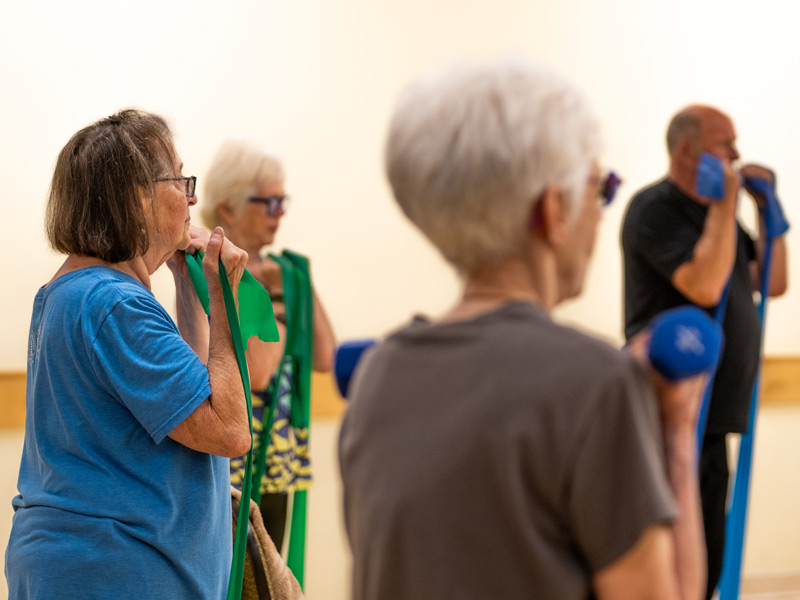
Participants consistently describe a second benefit they value just as highly as the physical gains: friendship, community, belonging.
Susan Clarke, 74, moved to Port Williams managing arthritis, osteoporosis, and fibromyalgia. The program has helped her on those issues, but that’s surprisingly not its crowning achievement. “Best of all, I’ve made great friends at the class,” she says. “AFL provides a comfortable forum to chat with people and gradually make friends — though not during ‘fast feet’!” she laughs.
Michael Kamras is a retired RCMP officer who relocated to Nova Scotia from Ontario. During his nearly four-year wait for a family doctor, he found AFL. He credits the program with helping him manage his Type 2 diabetes while also connecting him to his new community. “My wife and I originally met many of the people we are now friends with via AFL.”
The social dimension of AFL addresses something doctors are increasingly treating as a health crisis in its own right. Chronic loneliness among older adults is associated with higher rates of cognitive decline, depression, heart disease, and early mortality — and in a region where many seniors live alone or have outlived their social networks, a twice-weekly class with familiar faces can matter more than it might appear.
It’s not unusual to see a crowd leave the rec centre to share a coffee or a bite to eat together right after class. The filled chairs and happy chatter are appreciated by local café and restaurant owners.
The ripple effects extend even further: Participants volunteer, stay in the workforce, care for spouses and grandchildren, and remain engaged in community life.
Saralee Lewis, who will soon celebrate her 89th birthday, manages serious cardiac and joint conditions, lives independently, and sits as a working board member with five community organisations. She credits AFL as “an essential, irreplaceable tool” for making that possible.
“I can understand how someone might look at AFL and think it's 'just' a fitness program," says Dr. Fowles, "but the bigger picture is immeasurably positive. Participants get physically, mentally, and socially stronger. Instead of occupying hospital beds, emergency rooms, and nursing homes, they're out living their lives.”
“As we age, healthcare costs exponentially increase. With improved fitness and wellness, we can bend that curve down. That frees up potential funding for the other things that matter to so many Nova Scotians. The wins from a program like this cannot be overstated.”
— Dr. Jonathon Fowles, Director of Acadia’s Centre of Lifestyle Studies and Health and Wellness Institute
A pilot that has proven its case for sustainability
AFL has operated as a federally funded pilot since 2019, supported through the Canada–Nova Scotia Aging with Dignity Agreement administered by the Department of Seniors and Long-Term Care. That funding ends in March 2027.
Pilots exist to test whether a program works, whether communities need it, and whether the outcomes justify continued investment. On every measure, Active for Life has delivered. The data is robust, demand is documented, and the return on investment is clear. Classes fill within 24 hours of registration opening; waitlists are the norm. The Port Williams Village Commission notes that “every new session there is a lineup out the building.”
An outcomes report submitted to the funders makes the financial case plainly: the program and its companion physical activity counselling services cost approximately $200,000 per year to operate and generate an estimated $300,000 to $800,000 in avoided healthcare costs annually.
Because of this success, Dr. Fowles hopes the next step is to make Active for Life a permanent offering, and to bring it to more Nova Scotians as an innovative way to deliver healthcare.
Active for Life is delivered by the Centre of Lifestyle Studies at Acadia University’s School of Kinesiology, with support from community recreation departments across the Annapolis Valley.
This program’s decade of growth has been made possible with grants from the Eastern Kings Memorial Health Foundation, the Lawson Foundation, the Valley Regional Health Foundation, the Nova Scotia Health Chronic Disease Innovation Fund, the Department of Health and Wellness, the Department of Seniors and Long-Term Care, the Canadian Institutes of Health Research, and ongoing internal research support from Acadia University — alongside the community recreation departments that host these programs across the Valley.
For more information about Active for Life programs and registration, visit Acadia’s Centre of Lifestyle Studies website.