

Amplifying voices: interdisciplinary research is transforming student experience
When Késa Munroe-Anderson attended Acadia more than 30 years ago, she was a student of African descent from the Bahamas. “I remember the supports that were available on campus then and those that were not,” she says.
Across North America, racialized and international students have faced – and continue to face – systemic disadvantage, discrimination, and underrepresentation.
Today, Dr. Munroe-Anderson teaches in Acadia's School of Education. “Since my student days, Acadia has provided additional support, but we still have work to do to ensure our students in marginalized groups have a sense of belonging and can enjoy healthy wellbeing during their studies.”
In a new two-year study, Acadia researchers are partnering with students who self-identify as Muslim, of African descent, or international students in a project designed not only to understand their lived experiences but to help them thrive.
While Acadia is the case study, the project team, led by Dr. Ahlam Rahal (School of Education and School of Counselling), expects it to have wider application in Nova Scotia and across Canada.
STUDENTS HAVE A SAY IN THE RESEARCH
“Our research explores the needs of students who are historically marginalized and provides them with mentorship,” Dr. Rahal says. “I have a global background in mental health services; I'm also a professor in counselling. I wanted to recruit others with social justice and education backgrounds. All of us are from non-white cultural backgrounds, and our personal knowledge and experience were useful.”
Dr. Rahal’s co-researchers are Dr. Munroe-Anderson, Dr. Alicia Noreiga-Mundaroy (Community Development), Marissa Walter (Acadia Counselling Centre), Michaela Dankwa (research assistant), and Dr. Tareq Hardan (University of Northern British Columbia). The research team’s mentors are Dr. Barb Hamilton-Hinch (Dalhousie University) and Robert Wright (St. Mary's University).
The study is supported by a $99,703 Research Nova Scotia award, one of only four projects funded by the prestigious New Investigator in Addictions and Mental Health Grant for 2024/25.
Walter’s role in Acadia’s counselling centre is to support Black, Indigenous, and racialized students on campus. “It's exciting to me not only that this funding increases our capacity to better understand and respond to the psychosocial needs, but also that it’s a participatory model of research,” she says. “The students are active participants. They have a say.”
After collecting data via anonymous surveys, the researchers invited 15 students to take part in a series of 10 workshops over the academic year. Attendance and commitment remained strong: 11 students attended the final workshop in April 2026.
Discovering that others faced similar challenges, and developing a vocabulary to talk about them, helped the students to feel part of a community.
“Most were strangers when we started,” says Dr. Noreiga-Mundaroy, who was herself an international student in Atlantic Canada. “Over the series of workshops, they have built relationships. From those sessions we see a need for voices to be heard that could inform policies and meaningful action. What’s on paper doesn’t necessarily reflect the reality for marginalized students. Besides compiling empirical data that shows what's going on, we are trying to tap into resilience – what's working well, and how marginalized students support each other – and build that resilience.”
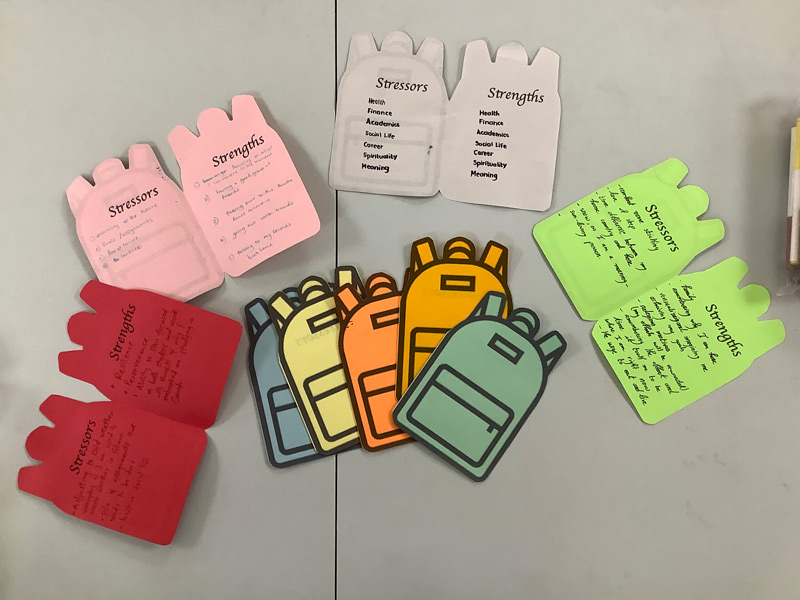
Through dialogue and group discussions, students have received a wide range of supports, including the following:
- developing the skills of self- and social awareness to understand how psychosocial experiences impact educational performance
- learning about the principles of social justice and equity and their influence on students' wellbeing and educational opportunities
- acquiring coping strategies and discovering internal strengths
- building a sense of community among participating students
- being directed to resources at the university and in Nova Scotia.
All 11 students who attended the final workshop asked to be involved in the data analysis. “We are not only mentoring students on how to deal with challenges,” Dr. Rahal says. “We are teaching them the academic skills to analyze the data with us.” Students who participate will be invited to take part later in conferences and publications.
NOT JUST LEADERS OF TOMORROW BUT OF TODAY
The students’ resilience has been inspiring, Dr. Munroe-Anderson says. “It's given me hope for our future. We have leaders among us who are international students, Muslim students, and Black and African students. We need to make space for their leadership skills to be developed and to use them in ways that can contribute to building our university community. We see them not as leaders of tomorrow but as leaders of today.”
“I am glad we created an environment for students to feel safe, supported, and understood,” Dr. Rahal says. “We emphasize the importance of the words, of hearing the students’ voices. The impact of participating in this study includes the student’s ability to name their experience.”
In addition to their challenges, the students possess power and resources, Dr. Rahal adds. “They can give something to the university. As a team, including the students, we aim to meet with administrative staff to discuss how the university can create a more inclusive environment for students. We have already partnered with community centres to see how we can provide community services to racialized and international students.”
“The goal here is not merely to have stronger support but to promote institutional change,” Walter says. “And the beautiful thing is that students get to be a part of creating that change.”