

There’s no single “right” path: Dr. Jane Francis on curiosity, taking chances, and coming full circle at Acadia
One minute, you’re a kid being asked what you want to be when you grow up: you’re free to imagine and dream big, with no strings attached. The next, you’re filling out university applications, double-checking prerequisites, and feeling like what you choose next will set your life’s path in motion. No pressure, right?
Those early decisions can start to feel like massive commitments rather than starting points. Program and career choices feel final. Changing direction can feel risky, or like a step backward. What if switching majors delays graduation? What if you change lanes and *that* doesn’t feel right either? What will your parents think?
But learning rarely unfolds in a straight line. As you gain experience and perspective, your interests are meant to evolve. It’s completely normal, and even wise, to shift gears as you discover more about yourself and the world around you.
Jane’s story: arriving at Acadia…twice
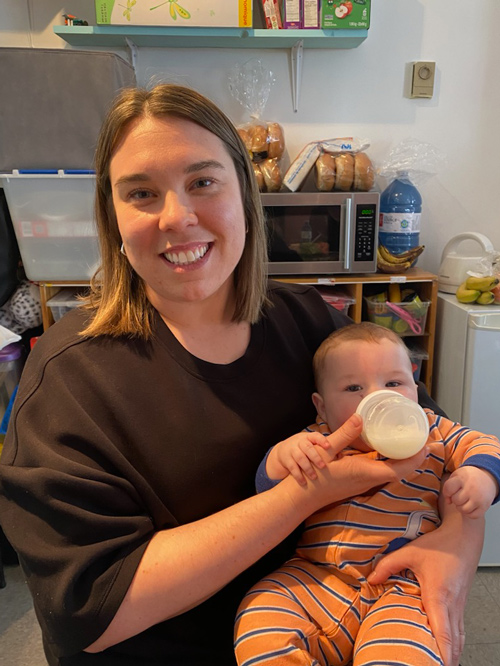 Back in 2007, 18-year-old Jane Francis ('11) arrived at Acadia University with a clear goal: to become a clinical dietitian so she could help clients improve their health through food and nutrition.
What Jane couldn’t yet know was how that plan would change, or how valuable those changes would turn out to be.
Nearly 15 years later, she returned to Acadia’s campus — as Dr. Jane Francis. When she came back in 2021, it was as a post-doctoral research fellow working with Dr. Lesley Frank in the Fed Family Lab, focusing on national issues concerning infant feeding, food insecurity, and maternal and child nutrition. Today, Dr. Francis is both a research affiliate with the Fed Family Lab and an assistant professor in the School of Nutrition and Dietetics. In her current role, she teaches and mentors students, many of whom are navigating their own life choices as she once did.
Her path was not shaped by a single long-term plan. Instead, it unfolded through curiosity, relationships, and a willingness to follow new interests as they emerged — and Acadia’s small size and mentorship culture played an important role in making that possible.
Learning by trying
When Jane began her undergraduate degree, she expected her path to be fairly straightforward. That assumption shifted in her third year, when a professor mentioned honours research opportunities in class.
“Research is sometimes daunting to students,” Dr. Francis recalls. “There are all these components to it. But I thought I might as well just learn about it, just in case.”
Though she still envisioned a career working directly with clients as a dietitian, her research project sparked an interest in paediatric and maternal nutrition. Jane applied for one of the few paediatric dietetic placements in Canada and moved to Toronto to complete a combined clinical internship and master’s degree in nutritional sciences. Like many first big steps after graduation, the move felt exciting and intimidating.
When a detour brings clarity
For her master’s, Jane joined a research team where she was involved in every stage of the research process and helped run clinical nutrition trials in the neonatal intensive care unit
The clinical internship gave her a taste of both what fit and what didn’t. “By trying things, you can discover what you don’t want,” she adds, “and that information can be just as valuable as finding what excites you.”
“I realized I didn’t want to work one-on-one with patients,” she says. “I wanted to work as a researcher, to be able to impact what dietitians do in practice.”
What might have looked like a detour became a source of focus. Each stage added skills, perspective, and confidence that shaped what came next.
Following the questions
Rather than choosing a single lane, she followed the questions that kept surfacing. Her work shifted from hospital-based neonatal research to a community-based PhD focused on infant feeding after hospital discharge, breastfeeding practices, and food insecurity among families with infants. Jane’s work was influenced by mentors in nutrition, public health, and anthropology.
Early in her PhD, she attended a conference where she heard sociologist Dr. Lesley Frank speak about infant feeding and food insecurity. Years later during the pandemic, Dr. Francis reconnected with Dr. Frank through a virtual book talk and reached out by email.
“I wanted to find a postdoc position and wondered if she was taking students,” she recalls. “And she was like, ‘Yeah, great, come.’”
That single conversation led to a postdoctoral fellowship, an ongoing collaboration, and eventually a return to Nova Scotia and to Acadia.
“I’m a planner, and I love to know what’s coming next,” Dr. Francis says. “But when I look back, so much of my career unfolded because of conversations with people and timing. Somehow, it worked out.”
A full-circle moment
Now an early-career scholar at Acadia University, Dr. Francis’s research on issues surrounding infant feeding continues to bridge disciplines. She frequently works with Dr. Frank through the Fed Family Lab, a collaboration that brings sociological and nutritional perspectives together to address complex health and social challenges with the goal of informing policy and practice at both national and community levels.
Her return to campus also marks a full-circle moment: Dr. Francis now teaches maternal and infant nutrition, the very course she moved to Toronto to pursue.
“When I was a student, Acadia didn’t have the maternal and infant nutrition course,” she says. “Now I’m able to teach it, and that’s really exciting.”
For Dr. Francis, teaching and research are deeply connected. “It’s a great way to show students what research actually looks like,” she explains. “And to say, ‘Hey, I’m working on this project,’ in the same way I learned about research as an undergraduate.”
Making space to explore
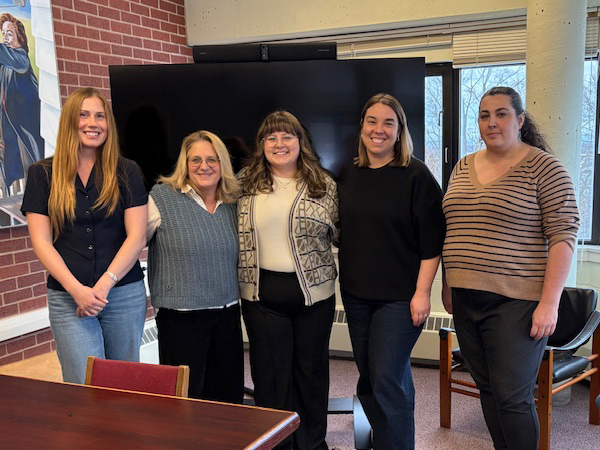 That approach is already shaping students like Ruby Harrington. The Acadia alumna began working with Dr. Frank and Dr. Francis as an undergraduate co-op student on a project that explored data from the 2022 North American infant formula shortage crisis.
“Before this, I had only ever worked in retail,” Ruby says. “I was really nervous.”
What stood out was the culture of trust among her faculty mentors. “They always cared about my perspective,” she says. “They’d ask what I wanted to do and how I felt about things.”
Through hands-on mentorship, Ruby gained research experience and confidence she didn’t expect. Rather than narrowing her options, the experience expanded what felt possible. Ruby went on to complete both an honours thesis and a master’s degree in politics, and continues working in research with the Canadian Centre for Policy Alternatives – Nova Scotia Branch.
“I didn’t come to Acadia knowing what I wanted to do,” she says. “But being in an environment where it felt safe to try things and change directions made a huge difference.”
For Dr. Francis, that sense of safety is one of Acadia’s greatest strengths.
“At a small university, you’re more accessible as a professor,” she says. “You can actually work with students and try things together.”
Dr. Francis adds a further note of encouragement and advice to students:
“You can have a rough idea of what you want to do,” Dr. Francis says. “But you have to be open to taking chances and trying something that interests you, even if it’s a little scary. Sometimes one move or one conversation can change everything.”
Finding yourself and your way at Acadia
At Acadia, students are supported as they explore, pivot, and grow — whether they arrive with a clear plan or none at all.
- Academic advising and career services
We offer guidance at any stage of your journey: in the admissions process, course planning and program changes, graduate school preparation, and career exploration. - Accessible faculty mentorship
Small class sizes and close-knit departments make it easier to ask questions, seek support, and build meaningful relationships with professors. - Interdisciplinary programs and minors
Students are encouraged to connect ideas across disciplines — reflecting how real-world problems are actually solved. In the process, you might discover new passions, interests, and talents within yourself. - Honours and undergraduate research
Many departments offer honours programs and research assistant roles, allowing you to explore research before committing to a specific path. - Co-op and work-integrated learning (WIL)
Paid, hands-on experiences, on campus and beyond, give you a real-world sample of a potential career, build confidence, and apply what you’re learning. - Counselling and mental wellness services
Feeling overwhelmed or stuck? Whether you’re navigating uncertainty, stress, or a tough conversation about changing direction, Acadia’s Counselling Centre offers support.
Remember: changing your mind isn’t a setback — it’s a part of learning.