

Dr. Martin Tango on Skill, Voice, and Self-Determination
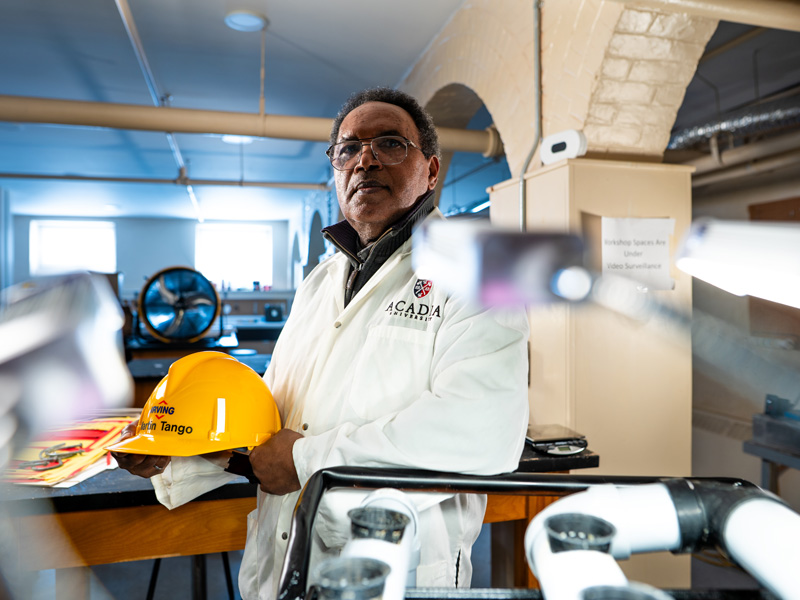 Dr. Martin Tango knows the value of self-motivation and self-empowerment because he lived it. From an early age, his success depended on beating the odds.
The Acadia Engineering Professor grew up in a small East African town where the only school nearby went up to Grade 4. From there, students took a national exam, and just one or two out of 45 would progress to Grade 5. Dr. Tango was one of them. Away from home at boarding school for Grades 5 to 7, he was again one of the few who made it to secondary school.
After completing Grades 9 to 12 at a technical school, he went on to earn a three-year college certificate. Then he fulfilled a year of military service before applying to university as a mature student.
“What would have happened if I was not one of those who made it from Grade 4?” he asks. “What would have happened to me if I was not one of those who made it to Grade 7? And what happened if I was not the lucky one to be in one of the two technical schools in the country? Probably, I wouldn’t be here. But, here I am.”
From Early Interest to Engineering Innovation
When asked how he got started in engineering, Dr. Tango says he followed his passion and penchant for physics and math while attending a leading technical school. His initial interest was in mechanical engineering: technical drawings, building things, and testing them.
He pursued a Master’s Degree in Mechanical Engineering, then joined an engineering design firm that collaborated with the Ministry of Industry. As he designed products like chicken feed mixers and bread dough machines, Dr. Tango realized that if he knew more about biological processes, his designs would be more effective.
He eventually moved to Canada, earned a Commonwealth Scholarship, and completed a Ph.D. in Biological Engineering at Dalhousie University.
“I drew an interest in using residual waste after the main product is produced to make a value-added product,” he explains, noting that his research focused on fermentation and byproducts from cheese production. “To me, that’s very inspiring. It makes me feel that I’m doing something very valuable.”
Connecting Students with Lasting Skills
Today, he brings his global academic experience and practical engineering knowledge to his classroom at Acadia. Since 2005, he’s been equipping Acadia students with practical skills and transferable knowledge they can use throughout their careers.
“You teach material, but you connect that with practical applications in the industry,” he says. “If they can comprehend that, I have done my job. But if, over time, they realize that what I shared on a topic has stayed with them and they’re using it time and time again, then there’s real value.”
“A student should feel connected. They should feel there is value.”
Through his role as a board member of Dalhousie’s Imhotep's Legacy Academy, Dr. Tango is also helping empower Black youth by creating after-school programming that introduces them to STEM topics through fun activities.
He does this work because opportunities like this weren’t available to him on his journey.
“If we can inspire or engage these Black kids, and indeed we are, guess what—some of the first cohort involved in Imhotep have graduated as dentists. They have Ph.D.s.” Dr. Tango explains. “I didn’t have this benefit in the past, but now I have a chance. I have a skill set. I can do this, and it’s good.”
Empowerment Through Effective Communication
Dr. Tango’s journey informs his perspective on this year’s African Heritage Month theme, For us, by us.
“For us, by us means everything we want to do, we are responsible for it,” he says. “We’re responsible for it. We want our voice heard, and there are things that matter to us as Black people. Then we are the ones who should make that happen.”
He adds that making things happen requires Black people to empower themselves with appropriate skills, especially effective communication.
“If you cannot communicate something clearly, then everything goes astray from there because we think about things differently,” Dr. Tango shares, noting miscommunication can lead to conflict.
“So to me, the core thing is: let something you want to be done by you be done in a clear way, the way you want it, and be communicated effectively. But you need the skill set.”
This perspective comes from lived experience. When he began teaching in Canadian university classrooms where there were fewer black people, he faced challenges, including racism.
“Along the way, racism comes in,” he says. “But you have to focus and keep working.”
The Power of People Skills
From his primary school days, Dr. Tango took on leadership roles—like managing the school’s livestock or working in the dispensary. He now puts his leadership skills to work by serving on Acadia committees, mentoring student societies, and serving on Engineers Nova Scotia’s Sustainability Committee. He is sharing these leadership skills with Acadia students through co-teaching an elective on engineering project management and leadership.
“It empowers kids on how to manage a project, about making decisions and conflict management,” he says. “It combines everything together.”
A critical component of this kind of project leadership, Dr. Tango says, is people skills. He says that even if you have a high level of skill in your profession, if you’re not proficient with communication and relationships, others can misunderstand who you are and what you stand for. It’s within these misunderstandings that racism can take root.
“But if we tell our stories—we let other people know what we value, how we think—then we wouldn’t have to talk about racism.”