

Curiosity at the heart of gaming, learning, and The Acadia Centre for Critical Play
If you’re wandering the basement hallways of the Vaughan Memorial Library and hear a distant “let’s a go!” you’re not hallucinating.
Nestled between rooms containing the Acadia Archive’s kilometers of books and paper is another kind of collection: the Acadia Centre for Critical Play (ACCP). Gathered in one space lives the entire span of video gaming history, from pong consoles released in 1976 right up to Clair Obscur: Expedition 33 on the PS5 and Xbox Series X, and an impressive selection of many thousands of games in between, along with over 50 consoles spanning 50 years.
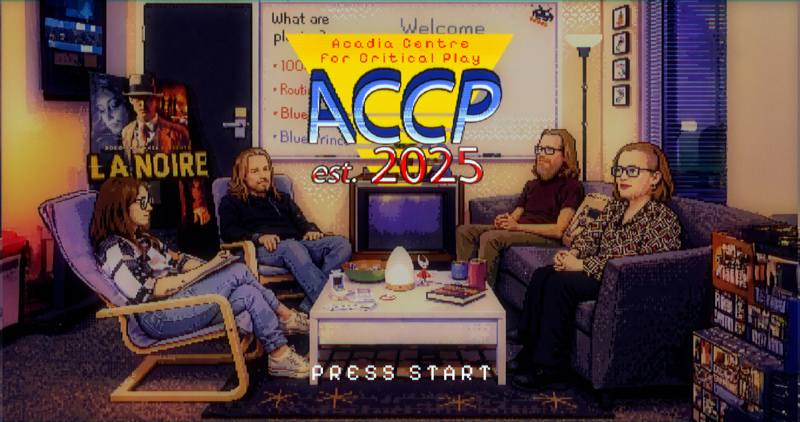
In 2025, the ACCP was ushered into being under the stewardship of its directors, Mike Beazley (Academic Librarian), Dr. Natalie Swain (History & Classics), and Dr. Jon Saklofske (English). Starting as a personal collection that had been “languishing” at Dr. Saklofske’s house, the trio have built something incredible.
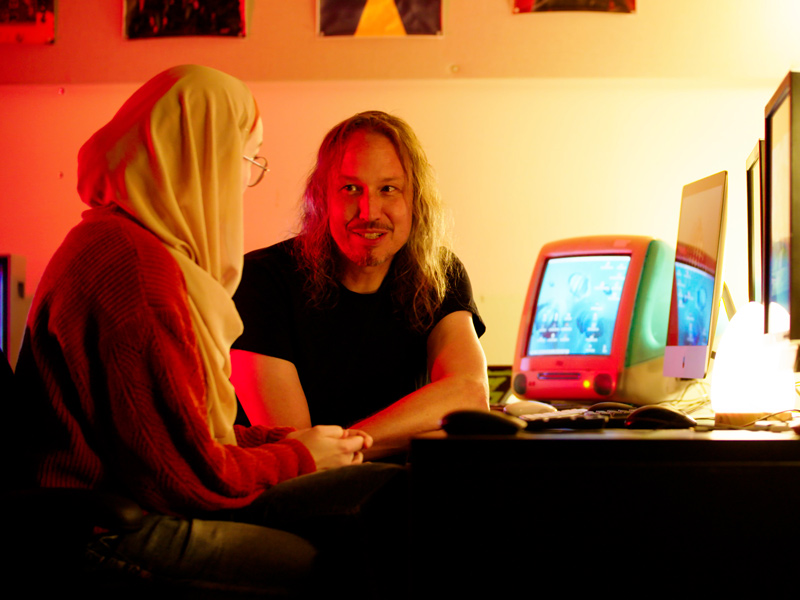 “This is technological history. This is media history,” says Dr. Saklofske. “We thought we'd try to find a place on campus where we could allow students and faculty and even members of the community to come in and experience that history more directly.”
While it’s an impressive collection in itself, even more impressively, the entire collection is playable. “We want this history to be used now, to come alive,” explains Dr. Saklofske.
“I think this is something a lot of universities would like to do,” says Dr. Swain. “In terms of higher education in Canada there are 3 or 4 other places similar to this.” And no collection is as accessible as what’s on offer at the ACCP."
The result is a unique resource for researchers in Canada allowing them to work with the entire history of a medium. The space is open to academics who want to look at how games intersect with their area of study, and instructors who want to bring video games into the classroom. And eventually, they hope to work with members of the public and community groups interested in digging into this playable history.
“We don't have to wait for 100 years for something to become valuable”
There are plenty of game skeptics who aren’t ready to bring video games into the classroom, but the ACCP directors are working to remedy that. To the skeptics, Dr. Saklofske points out that the advent of the novel was met with public outcry about it corrupting people and taking them away from work. “And now, we can’t even imagine a contemporary moment without the novel.”
“I think it’s so funny, because we don't have to wait for 100 years for something to become valuable.”
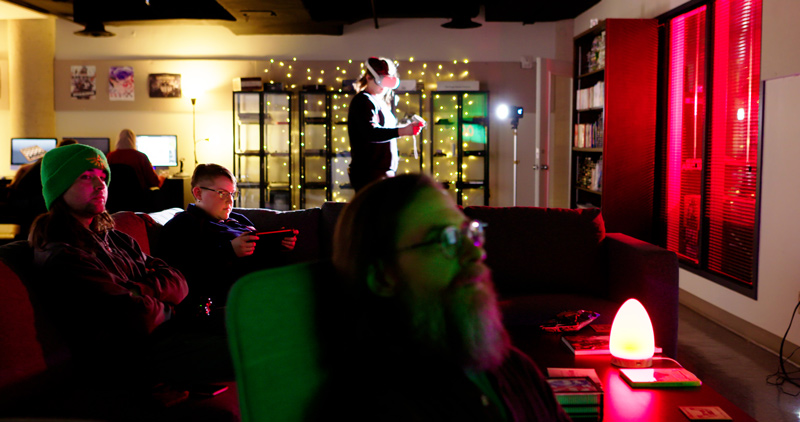 And find them valuable the ACCP directors do. "Games have all of the rich possibility of every art form; they’re the art form of our time,” says Dr. Swain.
“But not only are they really, really prevalent right now, they also add this other dimension of interactivity, which is something you don't get in most other forms of media.”
“Universities don't just look at history. We participate in public discourse about contemporary moments. And video games are a significant part of our present” says Dr. Saklofske. “The ACCP is intended to help to develop and encourage a game-based literacy, to be able to experience these interactive cultural experiences critically.”
Beyond accepting video games as a valid artform, the directors argue that they are especially worthy of study given how prevalent they are in the lives of students. If games are the artform of our time, and the place we encounter messaging about our current moment, the ACCP team argues it’s important that students critically engage with games to understand what messages they are being fed.
Essentially, if students are told the art they’re consuming isn’t worthy of examination, they hear that they don’t need to think critically about the messages games are conveying to them. Whether it’s about themselves or the world around them.
“It's engaging with students where they are and then using that to introduce these ideas of engaging critically with narrative, with the world around you, which is fundamentally what a humanities degree is supposed to do,” explains Dr. Swain.
Mike adds, “I think a part of it is giving students the opportunity to explore and to be excited about investigating something that they've already loved doing.”
“What better experience to have in a university than to come in with something you love and find out ‘Oh, wow. The people here treat this seriously. They don't dismiss this as something frivolous and silly. They understand the importance of the thing that I love. And they love it, too.’”
Beyond “reading” games
 The directors of the ACCP have taken incorporating video games in the classroom beyond reading them as texts. They use them in their courses as an alternative to the traditional essay. And they’ve had a great deal of success with it.
In her classes on Roman history, Dr. Swain has incorporated video games depicting that period, and had students study them as they would Ovid’s Metamorphoses, for example. Then, instead of producing a final essay, students had the option of making a playthrough video explaining what they’re doing and what the games are communicating to us about Roman civilization.
“I realize that what we do for students here is not just test their knowledge, but the assignment did reveal the depth of the students’ knowledge in a way that certainly wouldn't have come through in an essay. Their creativity allowed them to create this artifact that represented that knowledge while also representing that knowledge in a very unique way.”
For Dr. Saklofske, he’s taken it a step farther by having students design and build a video game, using easy to learn and open-source tools, rather than writing an essay in some of his English courses.
When they’re designing a game for his class, Dr. Saklofske explains that students “have to put information together and arrange it. We do that when we write essays and can communicate in other ways as well. So, they start figuring out how to make an argument in the form of a game.”
It’s not every students’ cup of tea, so he still gives the option of writing a traditional essay. But for those ready to try something new, it’s an exciting opportunity to learn creatively.
“It's a different kind of assignment. It's unfamiliar, it's a bit daunting, but I think it's exciting in that unfamiliarity. I think that working in an unfamiliar mode is one of the best ways to get them to start really paying attention to the assignment at hand.”
That was certainly the case for Gwen Trombly, who took a course with Dr. Saklofske in which she got to try her hand at creating an argument through a game. She describes the experience as “a very deeply thoughtful process.”
“You have to think about your understanding and how you're going to showcase it in an entirely different way than you're used to. You're not just looking at it to write it down in an essay, you're looking at it and thinking, ‘How can I develop this so that somebody can play this and understand the message that I'm trying to convey?’”
An added bonus to assignments like this, Dr. Swain points out, “is that as soon as you start asking students to do assignments that are not what they expect, they're less likely to fall back on ‘well, I'll just get ChatGPT to do it.’”
Curiosity at the heart of gaming
“The world is a rapidly changing place,” Mike philosophizes. “And if all you know how to do is meet curriculum goals, you're going to be limited. You need to be flexible. You need to be excited. You need to be curious. You need to be excited about problem solving, about researching, about learning new things.”
The ACCP directors see that curiosity, flexibility, and excitement about problem solving at the heart of both game play and learning.
“People tend to give up in real life more easily than when playing a game,” says Dr. Saklofske. “When players encounter obstacles in games, they bring curiosity and enthusiasm to problem solving. Even though a player might ‘die’ hundreds of times playing Mario Brothers, they keep trying. There's something really unique and valuable in that.”
“That curiosity that you experience in games can be a really good way for students to reconceptualize learning,” Dr. Swain adds. “It’s not something you have to do. It's something that is actually very rewarding.”
“With the advent of AI possibly reshaping the labor landscape in a lot of unpredictable ways, those skills like curiosity, enthusiasm, problem solving, the capacity to research, the capacity to think critically, all of those things are what students are going to need,” says Mike.
Hopes for the centre
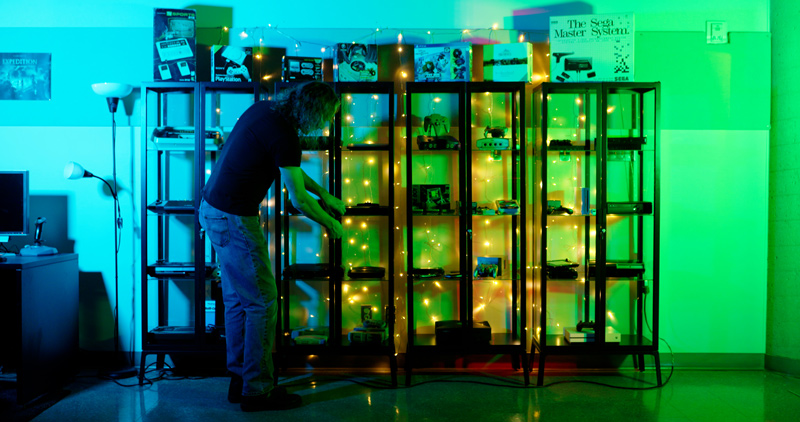 Though it’s in its fledgling days, the ACCP team has big dreams for the potential of the centre. They’re hoping that enthusiasm they see in their students will spread throughout Acadia, and other faculty will want to get in on it.
“We would love to see video games incorporated into all of the corners of our humanities program, not through necessity, but through faculty and student interest,” says Dr. Swain.
“I’m so happy that we have this space at Acadia,” adds Dr. Saklofske, “because it helps with the community here. But also, I think it could become a community hub for game studies in the Atlantic region.”
“The dream is to have this as a hub for community, connection, and collaboration. I think those things are really important to us and really at the heart of things that we value,” says Mike. “Our hope is that people who are interested in engaging and exploring ideas through games, with games, and about games will get in touch with us so we can get some cool projects going.”
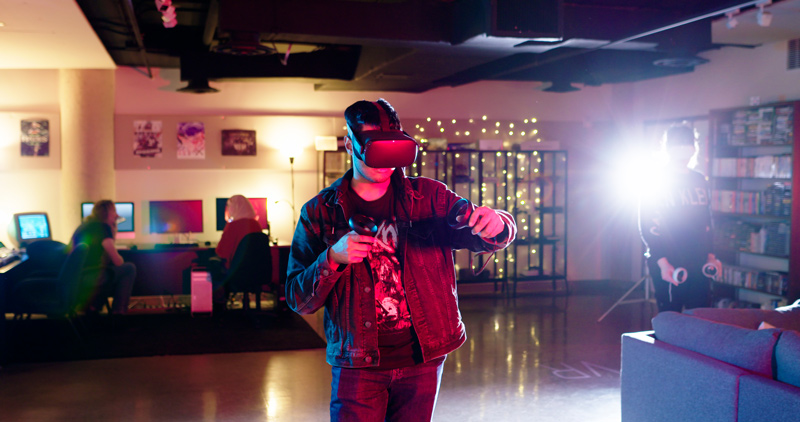
“Games are not going away. Humans have played games way before computing machines and these technologies were involved,” says Dr. Saklofske. So, he urges, “put on a VR headset, give it a try.”
“It's here on campus for you to explore.”
Pick up your controller
Stay tuned for “gaming for the gaming curious” sessions for both faculty who want to learn about incorporating video games into the classroom, and young researchers who want to learn more.
The ACCP will also be hosting game jams and will have plenty of other opportunities to get involved!