

How two McCall-MacBain Scholarship finalists found themselves and their paths at Acadia
The two Acadia finalists for the McCall-MacBain scholarship have vastly different life experiences and scholarly expertise, but they have one important thing in common as they come to the close of their Acadia days.
Both Nick Lundrigan and Rowan Norrad found themselves at Acadia.
“Nick and Rowan truly exemplify what it means to be an Acadia student. While their paths leading to and during their Acadia education have been different, both reflect courage, curiosity, and a desire and drive to improve lives and contribute to societal change,” says Ashlee Cunsolo, Provost and Vice-President, Academic.
“What makes their academic and community accomplishments so inspiring is that they unfolded along with a journey of self-discovery and personal growth, which has shaped them into the scholars and people they are today.”
Now, as they prepare for the next chapter of their lives—and the final interviews for the prestigious McCall-MacBain Scholarship, taking place in March—they each have newfound confidence in themselves as scholars and leaders.
The McCall-MacBain Scholarship is one of Canada’s biggest scholarships, rewarding students who have shown excellence in leadership. The successful candidates go on to complete their graduate studies at McGill University, and become part of a global mentorship network of other McCall-MacBain scholars.
To get Nick and Rowan to the finalist position in the competition, they had to demonstrate how they lead in their communities and how they will affect positive change with the course of study they intend to pursue at McGill.
But before they could lead others, they had to find themselves. That is exactly what they did during their four years at Acadia.
Finding their footing
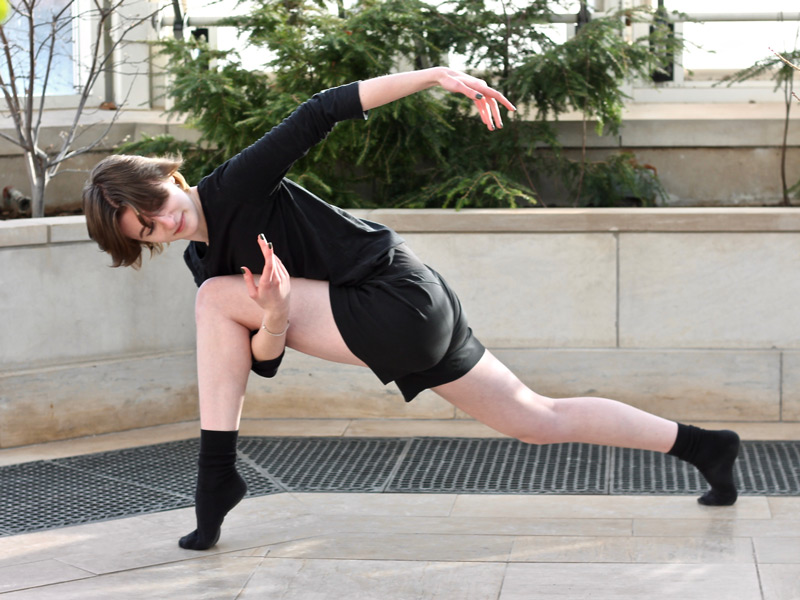 For Nick, finding themself meant fully embodying their truth, and connecting with community where that would be celebrated. Upon arriving in Wolfville, they found this community through the Acadia Dance Collective.
While they’ve been dancing since kindergarten, Nick has a different relationship with the artform now than they did all through school in their hometown of Sackville, New Brunswick. While Nick loved dance itself, the constraints of what was expected in traditionally trained dancers didn’t fit with who they were growing into as a person.
"Dancing in high school had a real impact on how I allowed myself to express my gender identity. I was so committed to dance that I didn't want to shift anything at my dance studio. I didn't want to disrupt anything, so I endured in a haircut and clothes that didn't feel like me."
Reconsidering what dancers “should” look like—from costumes and hair based on the traditional gender binary to an expectation that dancers would fit a singular (thin) body type— was just the first piece of what would be a major transition in Nick’s relationship with dance, their understanding of representation, and themself during their time at Acadia.
After participating in the Dance Collective in their first year, they became Vice President as they went into their second year. Later, they went on to become Co-President.
“I feel that strict expectations surrounding peoples' identities and bodies, which are often rampant in competitive dance environments, serve more to breed insecurity than confidence,” Nick explains. “Dance is very vulnerable. Expressing yourself through your body can be incredibly empowering, in an environment where you are able to be wholly yourself. Where you are can choose how to present yourself without worrying about rocking the boat.”
“Being a part of the Dance Collective for the past four years has allowed me to reconnect with all the of those things that I loved about dance in the first place.”
Throwing off the expectations of others around how dancers show up on stage has given Nick back the joy they first felt in dance as a kid, and led others at Acadia to follow in their footsteps. They wanted the other dancers to feel that same freedom to express themselves authentically that they had found.
“I’ve tried to make it very clear in a position of authority in the Dance Collective that the most important thing is that the dancers feel good on stage,” says Nick. “It’s hard to bring things up and disrupt norms. So I try to be the person to start the conversation to make it easier for other people.”
Representation, from stage to stacks
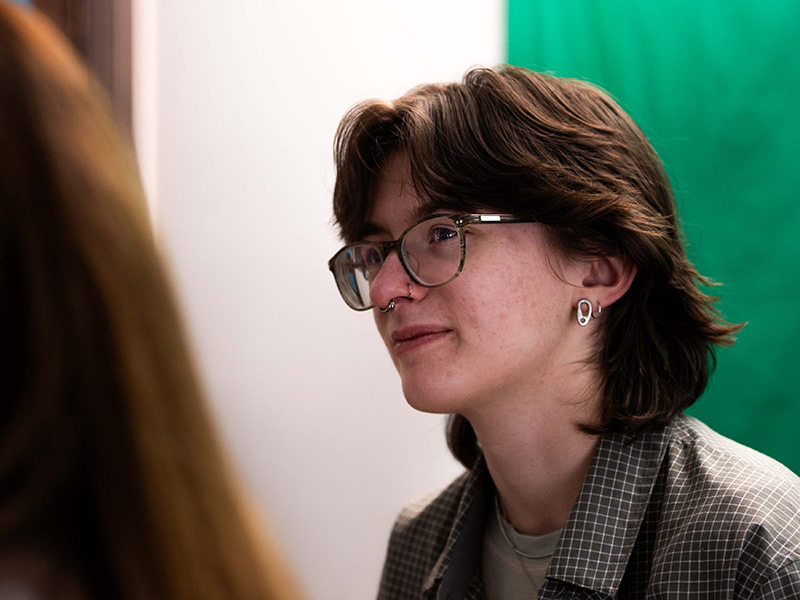 As with Dance, Nick found that their relationship with libraries changed through their time at Acadia as they discovered the power of representation in archival records and stories. And now, with the support of the McCall-MacBain scholarship, they hope to pursue a Master of Information Studies at McGill.
After working alongside Ciaran Purdome (Digital Archivist, Acadia University Archives) on a project to capture student perspectives on the official record, Nick saw how preserving stories of marginalized voices in an institutional narrative changes history. “If we prioritize student voices in the archives, then it will have a historical impact on how Acadia is remembered and perceived,” they explain.
“Nick is the kind of student who makes me excited about the future of the field,” says Ciaran Purdome. “They came to our project with genuine curiosity and helped students understand that their stories belong in the archive. They understand that information systems reflect power dynamics in society and creating space in these colonial systems requires both critical thinking and genuine community trust. Libraries and archives are going to be richer, more just places because of the work they will do.”
Because of the colonial roots of archives and collections, Nick says that there’s often a disconnect between libraries and the actual makeup of the community they’re in. But they see libraries as a space full of potential.
“My goal is to establish libraries where the collection reflects what the community wants to read about, what the community is interested in.”
Seeing how representation in dance studios and libraries impacts others has inspired Nick to pursue a path towards creating libraries and collections that accurately reflect the communities they’re situated within, “rather than an abstract diversity without concrete connections.”
“It’s important for people to see themselves reflected in archives because it can serve as evidence that you’re not alone. Even though it’s easy to feel like your experience is something only you have gone through—which is true—it’s simultaneously true that other people have experienced similar things. And if they made it through, so can you.”
Identifying his path
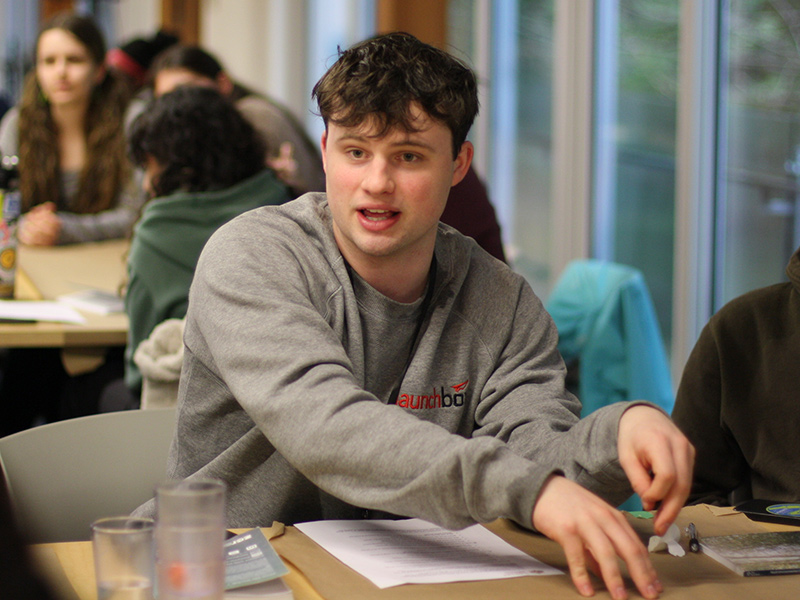 For Rowan, Acadia gave him the gift of a path. He began his time at Acadia as a 2022-2023 Arthur Irving Scholarship recipient.
He says that all his achievements at Acadia are important to him—whether he’s winning national social innovation pitch competitions or securing funding for carbon sequestration technology.
“But my biggest achievement is figuring out what I want to do with my life.”
Growing up, Rowan occupied his summers searching for and identifying fossils on the shores of New Brunswick near his family’s cottage. “I spent my days as a kid flipping over rocks eight hours every day, and my mom would worry I’d get dehydrated or sunburnt because I would spend so much time out there,” he recalls.
Since he began flipping rocks, finding and following a passion has never been an issue for Rowan. His problem, though, was that all areas of science were something he wanted to pursue. Then, he came to Acadia and discovered environmental science.
“I like it because it’s a little bit of everything, kind of like an intro class to all sciences at once,” he explains. His work over the last four years has focused on looking for ways to sequester the carbon dioxide in our atmosphere that causes climate change.
“Even if we move to completely green energy tomorrow, there will still be stores of CO2 in the atmosphere. So, there have to be solutions on both ends of the equation: decarbonization and carbon dioxide removal.”
Windows into different worlds
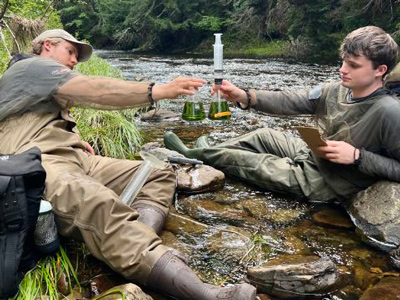 While climate change and fossils may seem like entirely different worlds, for Rowan, it’s a natural evolution of his interests. “Fossils and paleontology show you windows into completely different worlds, worlds where the climate is immensely different from what we have now,” he explains.
“Learning about that and how climate has changed over hundreds of millions of years and how many different climates we’ve had, that sparked an interest in trying to understand the changes in climate we’re seeing now and how humans are changing it so rapidly.”
Rowan plans to dedicate his life to bringing about yet another different world—one in which the technologies he is working with make a significant difference in the fight against climate change.
Beyond technological advances, it will take thoughtful leadership to make real change. Rowan counts himself as lucky to have had a front-row seat to what’s possible through relationships and community at Acadia.
“Acadia and all the professors I’ve met have afforded me amazing opportunities to grow, to learn, to achieve. And that’s because I was in class asking questions and they were there ready to answer. I think that this small, close-knit community gave me the opportunities and I just capitalized on them.”
Having made the most of those opportunities, Rowan hopes to pay it forward by being the kind of leader who can create an environment where people can bring together diverse ideas and unique life experiences.
"These are the people who, rather than just teaching me something, changed my life”
While the Acadia chapter of Nick and Rowan’s lives are ending, their futures are bright. Whether they head to Montreal as McCall-MacBain scholars, or follow a different path, they’re both looking forward to taking the lessons in leadership they learned at Acadia into a future of leading with empowerment, curiosity, and passion.
“At its heart, an Acadia education is about finding yourself, your voice, your passions, and your place in the world, and developing the skills and confidence to lead with integrity and purpose,” says Ashlee Cunsolo. “Nick and Rowan embody these attributes, and we are so proud that their achievements – and their hearts and characters – are being recognized through their selection for the McCall-MacBain Scholarship.”
“What I’ve achieved wouldn’t have been possible without the people I met,” says Rowan.
“Whether that’s my friends I hang out with on the weekends, my profs, or my supervisor. These are the people who, rather than just teaching me something, changed my life.”
Cover photo of Nick courtesy of Mary Knockwood