

Social Justice at the Centre of the Black Brilliance Research Circle
By Angel Percentie
Angel Percentie (she/her) is a fourth-year English honours student who loves getting involved on campus. She is a resident assistant, peer writing tutor, student content creator, and editor of Estuary, Acadia’s creative arts magazine.
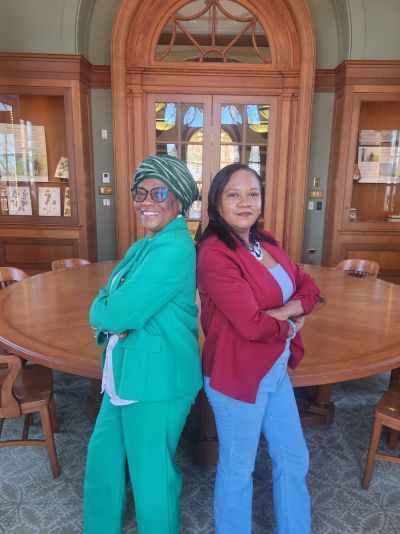
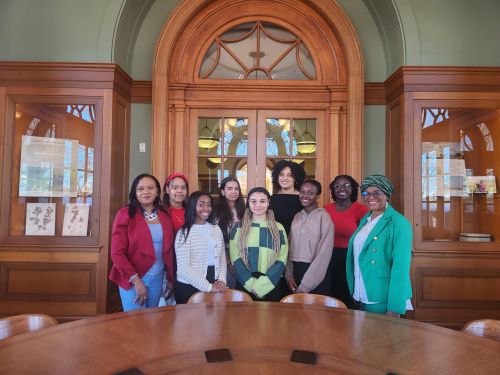
At Acadia University, three faculty members and seven students are working to reimagine what research looks like when the voices of Black students are central to education and social justice.
The Black Brilliance Research Circle (BBRC), housed in the Department of Community Development, began as a conversation between Dr. Alicia Noreiga-Mundaroy, Associate Professor, and Rev. Dr. Marjorie Lewis (Manning Memorial Chapel). They noticed that too few Black students were being mentored into research pathways that could lead to graduate studies.
“When you look at convocation,” Dr. Alicia began, “not many of the Black students were crossing the stage as part of an Honours program.” The question was not whether students were interested in research, but rather what barriers prevented them from engaging in it.
The turning point for this initiative came after a conference hosted at Acadia, where Randy Headley, Black Student Advisor at Mount Saint Vincent University, and one of his student researchers presented work emerging from their Black Research Circle. Dr. Alicia and Rev. Dr. Marjorie’s reaction to Headley’s initiative was immediate. Rather than reinventing the wheel, they reached out, collaborated, and the Black Brilliance Research Circle was born here at Acadia.
With support from a Social Sciences and Humanities Research Council (SSHRC) grant and other funding, the first students were recruited for a pilot year beginning in fall 2025. These student researchers include Hawa Momo-Seh, second-year Honours student in Women & Gender Studies; Nandir Usman, third-year Honours Psychology student and Mathematics double major; Deja Forbes, fourth-year Psychology B.A. student; Michaela Dankwa, a Master of Applied Kinesiology candidate; Kiera Way-Hopkins, second-year Psychology student; Jaiana Sharpe, fourth-year B.Sc. student in Applied Psychology; and Keira Grady, a third-year Environmental Geoscience B.A. student.
The first semester consisted of training workshops designed for students to learn research strategies that explored feminist and social justice frameworks. Now in its second term, the students are split into two groups; Dr. Alicia mentors one and Dr. Lewis mentors the other. Each group will write two papers, one autoethnographic piece from their study and one based on a case study.
Dr. Marjorie shared from her own research journey that while completing her PhD at the University of Birmingham, she found crucial support through a Black theology research forum. “I got my PhD through community,” she said. “I did not have the basic skills when I started. It was Black scholars, especially Black feminist scholars, who said to me, ‘You can publish.’”
For student researcher Kiera Way-Hopkins, placing Black voices at the centre of research means addressing the topic of belonging.
She suggests that “If you feel disconnected or feel that you don’t know where you fit in,” research may very well start with “reconnecting with where you come from.”
It is this grounding in lived experience that the BBRC hopes to cultivate in young Black scholars.
Centering Lived Experience
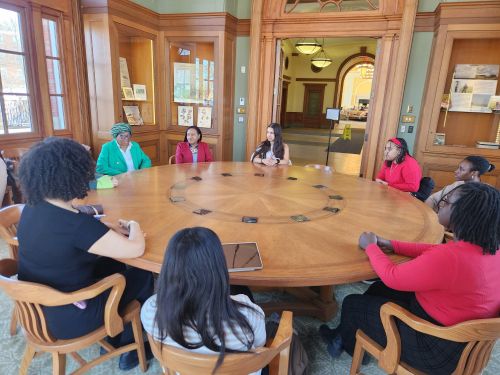
A defining feature of the BBRC is its emphasis on lived experience, particularly through the use of autoethnography, a form of research that applies personal experience to broader conversations about social justice.
Autoethnography allows students to position their lived experience as knowledge.
For many of the student researchers, writing has become both academic and reflective. Jaiana Sharpe explains, “Writing this paper helped me realize how far I have come in four years at Acadia.”
“The opportunity to learn about the experiences of others quickly made me realize that I was never alone. There were others like me, going through a similar process too... our shared experiences are just a part of settling into a predominantly white institution.”
Jaiana’s reflection says a lot about the impact of authentic Black voices on creating a collective understanding. Similarly, Hawa Momo-Seh shared that BBRC has allowed her to “critically interpret [her] experiences as a Black student to reveal the gaps within institutional structures, belonging, and support systems in postsecondary education.”
Redefining Brilliance
In the context of the BBRC, brilliance is about impact. To join the words Black and brilliant is deliberate, a combative act that challenges the language that has historically been used to bar Black researchers from academic spaces.
“Brilliance is about how much the students matter,” Dr. Alicia explained. “It is about their contributions to the world.”
Student researcher Nandir Usman extends this understanding, stating that it is the role of the Black scholar “to recognize that knowledge is not meant to be kept in isolation. It must be shared and built upon.”
Janique Ellis Panza, Coordinator of Black Student Affairs and assistant facilitator within, situates this redefinition brilliance, to also include helping black students see themselves in academic spaces. She wants “students” to be excited about research and to know that it is an option for social justice,” because “as Black people, that is the lens we should use when researching things about us.”
Institutional Responsibility Beyond Representation
For student research assistant Deja Forbes, institutional support is deeply connected to identity formation. She shares that university has helped her see her identity in “a more rounded and open-minded way,” highlighting the “fluidity of life and the beauty of growing, learning, and self-correcting" as well as the barriers for Black identities and the necessity to correct systemic discrepancies.”
The conversation turned candid when discussing institutional responsibility to support Black students.
Janique emphasized the importance of moving past representation. “You are welcoming first and second-generation students into this institution,” she said. “All the responsibility belongs to the institution to provide resources and guidance.” That responsibility includes trained advisors, meaningful mentorship, and sustained institutional investment. At the same time, Janique highlighted that “It is all of our responsibility,” both the Black community and the wider academic faculty, to nurture the research capabilities of Black students.
While the Circle’s SSHRC funding currently supports some expenses, they hope that the BBRC will become embedded within the university’s structure and sustained for years to come.
Leaving a Legacy behind
For the BBRC, success isn’t measured by numbers. They hope to empower Black students by showing them that research is an option. Students should not feel limited because of where they come from or the colour of their skin. Nor should the university pose a barrier for them to achieve higher learning. This initiative is the beginning of academic spaces where Black students can nurture their love for research.
There are so many questions and possibilities yet to be explored, and these questions are shaped by how these students understand their sense of belonging within the university. Michaela Dankwa reflected on the mindset that fuels the scope of research but starts with how Black students see themselves.
“Coming to Acadia, I've realized how uncomplicated identity can be when you let yourself explore the kind of person you want to be; we don't have to tie ourselves to who we were or who people think we are or ought to be”. Her words highlight the freedom to reflect on identity on a personal and academic level.
It is the goal of the Black Brilliance Research Circle to let Black students know that research is an option within their reach, regardless of whether they are a part of an honours program or not. Social justice transcends the classroom, and here at Acadia, the BBRC invites Black students to conduct research that drives meaningful understanding and collective growth.
With initiatives like these, they are curating spaces for Black students to be brilliant.