
Supporting Indigenous Students, One Connection at a Time
For Jordan Smith, returning to Acadia University was more than a career move. It was a chance to help create the kind of community she once needed herself.
After graduating from Acadia in 2014 with a degree in kinesiology, Jordan spent much of the past decade in community development: first in Glooscap First Nation, her home community, and later at a non-profit in Halifax serving Indigenous youth.
When the newly created role of Indigenous Student Advisor opened up at Acadia, it felt like the right fit.
"It felt like a really full-circle moment," she said.
Jordan knows what it's like to navigate university as an Indigenous student searching for connection.
She started at Dalhousie, where one class had about 400 students, which was a shock coming from a small First Nation community where everyone knows each other.
After her first year, she transferred to Acadia. Smaller classes and closer relationships with professors helped, but she still remembers feeling separate from the wider student community.
"I knew I belonged, but I kind of felt like I didn't fit in," she said.
That experience shapes how she approaches her role.
Maintaining Connection and Building Belonging
"Indigenous students face unique challenges within post-secondary institutions and may also define success differently than their non-Indigenous peers," she explains.
She notes that just 16 percent of Indigenous people hold a university degree, compared to 36 percent of the general population. But only 8 percent cite academic challenges as their reason for leaving school.
"So 92 percent of the time, when students leave university, it's because they're missing home, they have family obligations, or they're facing other unique challenges on top of the regular experience of adjusting to university."
Jordan’s role is to support Indigenous students' academic success and wellness by helping them maintain a connection to their culture and community, and by building a sense of belonging on campus.
That might mean connecting them with academic resources, helping them identify who to speak with when struggling, or simply offering a safe space to gather.
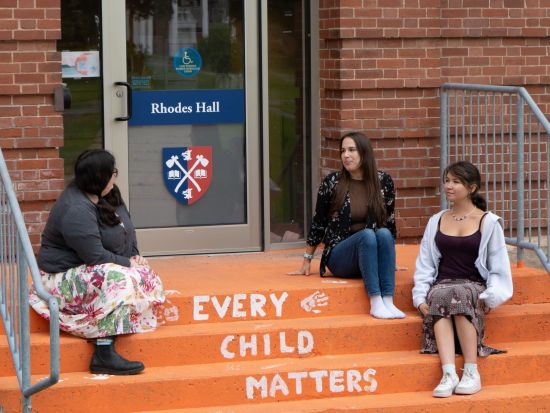
“A big part of it is simply providing space for them to gather,” she says. “They’ll often decide to have a movie night or study session together. Those aren’t things I’m necessarily facilitating. They just need a space where they feel comfortable. The Indigenous Student Lounge is a great resource for that.”
Jordan also wants to build a network of Indigenous peers who understand the challenges new students face.
"When new students come in, there will already be a group of Indigenous mentors who can connect with them," she says. "That way, they don't feel like they're the only ones going through the experience."
Some students struggle with being far from home or adjusting to unfamiliar social norms. Others arrive already feeling disconnected from their culture and looking to reconnect.
Part of Jordan's role is connecting students with local Mi'kmaq communities, elders, knowledge keepers and cultural teachers through activities like beading and quillwork.
"That disconnection is a result of colonization and the loss of culture," she explains. "We open up those conversations with students: you are not alone in that experience."
Building Community Beyond the Campus
Community building extends beyond Indigenous students.
Jordan’s role also involves creating opportunities for the broader Acadia and Annapolis Valley communities to learn, participate and build relationships. That includes the Midwinter's Feast, an event open to the whole community.
At last year's feast, she remembers children playing while people ate, talked and shared stories. "That kind of chaos felt like community to me," she said.
"There was a lot of storytelling and sharing that made the non-Indigenous community feel like they could connect in a really positive way."
She, along with a planning committee, is also emphasizing broader community participation for Mi'kmaq History Month, since reconciliation shouldn't leave Mi'kmaq people solely responsible for education and programming.
"The intention behind Truth and Reconciliation is not for the Mi'kmaq people to hold all the responsibility for hosting and educating people," she said.
Instead, she often helps non-Indigenous people find appropriate resources and ways to engage meaningfully.
Healing and Wellness Through Understanding
The theme for Mi’kmaq History Month is “Healing and Wellness Through Understanding.”
Healing and wellness, from an Indigenous perspective, go beyond physical health or academic achievement to include emotional, spiritual, cultural and community wellness—including relationships to people, land, animals and water.
"Yes, I am here to support academic success," she said. "And we also want these students to continue thriving after they complete school."
For Jordan, that means helping students build relationships, confidence and a sense of belonging that lasts beyond their time at Acadia.
She's also optimistic about a generational shift she’s observed toward more freedom in Indigenous cultural expression.
Today, she can wear a ribbon skirt or sell her beaded earrings with pride in a way her grandmother could not.
"I feel like it's really important for me to continue to be an optimist and feel like I'm contributing in a positive way to addressing these issues," she said.
Returning to Acadia has given her another way to do that: helping students find support, build community and know they don't have to navigate university alone.