

From the Classroom to the United Nations: Transformational Mentorship and Black Excellence in Action
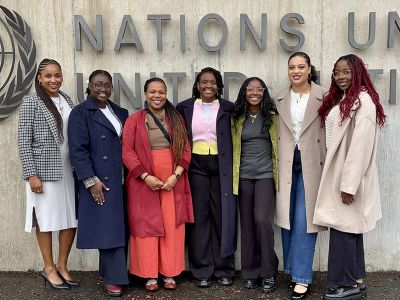
It all started with someone believing in them before they could believe in themselves.
Reflecting on speaking at the United Nations Youth Council during the Permanent Forum on People of African Descent, TaNyah Gibson says, “I was so nervous to speak that my palms were sweating.”
Seated nearby, Lerato Chondoma (Associate Vice President, EDI-AR) wasn’t nervous. That’s because she already knew something that Acadia's Black student delegation was now learning: they weren’t being introduced to the world stage there in Switzerland; they already belonged on it.
After speaking, TaNyah started seeing that she belonged, too.
“During and after speaking I felt so powerful being in a space and having my voice heard and valued.”
There on the floor of the UN General Assembly, TaNyah, along with her fellow students, Michaela Dankwa, Megan Glasgow, and Itai Kuwodza, were ushered into a new era of confidence by their Acadia mentors and travel companions, Lerato, Janique Ellis (Coordinator, Black Student Affairs), and Marissa Walter (Psychologist, Acadia Counselling Centre).
“Dreaming for them until they believed it themselves”
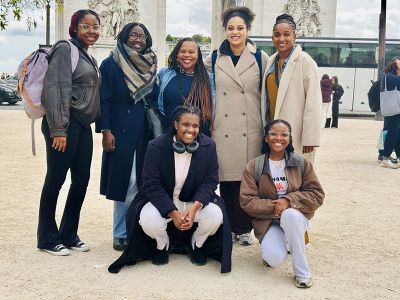
Before landing in Geneva, there were plenty of logistics to deal with, from fundraising to visas to transportation. But the biggest part of the preparation, for Lerato, Janique, and Marissa, was grounding the students in the substance of the work. Helping their students imagine themselves taking a central role in international policy, and believing they belong there was key.
“It started with dreaming for them until they believed it themselves,” says Lerato. “That was the first and most important work; helping young Black students from a small university in Nova Scotia believe that their voices had a place on a UN floor. Once that seed was planted, everything else followed.”
Studying in a predominantly white environment, where professionals, business owners, and employers rarely reflect their identity, “can cause limited imagination for our Black students,” explains Janique.
“This experience shattered those limitations. It reframed the students’ imaginations and gave them a better outlook on their possibilities. The impact has been significant and transformative.”
Marissa says that preparing the students to speak on an international stage was “incredibly meaningful.”
“It was a powerful example of what can happen when students feel seen, supported, and grounded in their cultural identities. That process didn’t just prepare them to speak, it allowed them to show up authentically on that stage.”
With that unwavering support, preparation, and belief, the students who made interventions on the UN floor learned what they were capable of.
“There is something magical about being surrounded and supported by Black mentors who are certain of your capability, knowledge, and authority,” says Michaela.
“They stood behind me, uplifted me, and carried confidence until I found my own. When my voice shook or I stumbled over my words, I couldn’t help but smile because I was speaking at the UN, and people were listening, nodding, and seeing value in my statement.”
“It’s excellence in motion. It’s Black beauty, it’s joy”
It’s impossible to talk about the experience these students and their mentors had without mentioning the pure joy of it all.
The undeniable glow emanating from post-Geneva Lerato is just as striking as the memory TaNyah shared about the fit check videos they made each morning, setting the tone for the day: “Everyone’s personalities were expressed in how they dressed and watching them show up authentically was a truly beautiful experience.”
Marissa recalls a moment when one student rehearsed her statement among the Acadia delegation. “We were standing in a circle, fully present with her, nodding and smiling. And when she finished, the room erupted in celebration, including the popular Caribbean ‘bup bup bup’ expression of excitement.”
Michaela says “there wasn’t a moment of this trip that wasn’t full of laughter. No matter how early we woke up or how long the day felt, we were always laughing and smiling. If we couldn’t find a reason to, we made one.”
In an interview, Janique told CBC that “It was empowering to be in a space of world leaders loving on Black people. It felt like home for me being in a space where Blackness is uplifted.”
“It’s excellence in motion. It’s Black beauty, it’s joy,” says Lerato.
Actual—not model—UN
Of course, global affairs are not light. And while students around the world participate in model UN competitions regularly, these Acadia students were part of the real deal. And the subject matter they were involved in was heavy.
Before the session, Ghana put forward a resolution to recognize the transatlantic slave trade as “the gravest crime against humanity.” The non-binding resolution, which the Ghanian President called “a pathway to healing and reparative justice,” was adopted with 123 votes in favour. Only three countries—America, Argentina, and Israel—voted against the resolution, but 52 abstained from the vote.
Canada was one of those 52 countries.
In an interview with CBC’s Information Morning, Lerato said Canada's decision to abstain was “demoralizing;” a “missed opportunity to align its international posturing with its domestic anti-Black racism commitments.”
Despite the missed opportunity, Lerato says there is a clear path of practical steps forward for Canada to address systemic anti-Black racism through policy, legislative, and programmatic reform. To begin with, she sees an opportunity for Canada to make changes to the employment equity act and Black justice strategy.
Similarly, the rest of the Acadia delegation left Geneva feeling hopeful for the future of reparatory justice globally for people of African descent. Janique described the session as “a really impactful set of conversations to inform what we do next as people of African descent globally and what we take back to our communities.”
Michaela found it heartening to be in a room with “a great many people invested in the betterment, success, and justice for people of African descent across the diaspora.”
For Megan, the experience left her “feeling motivated and hopeful for the future.”
A milestone, but not the destination
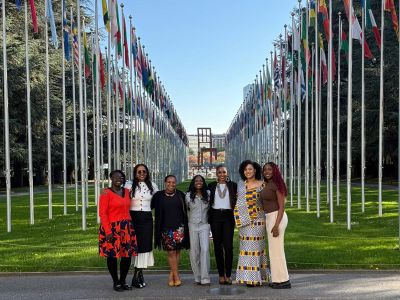
TaNyah and Megan will be graduating this May, and Michaela will follow them across the stage shortly after in October. While the students are unsure what their futures look like, they aren’t bothered by the uncertainty.
Megan says she doesn’t know for sure what life will look like post-graduation. But, she says, “I am affirmed in knowing that it will involve doing meaningful work within the Black community. Not only as an advocate, but as a community builder.”
For Michaela, she’s looking forward to her next steps. She says they are “to explore and invest in the pathways that will let me be the change I want to see in the world and that will bring me joy.”
These students all know that they have voices worth hearing, and just as importantly, they have steady hands at their backs guiding them through whatever the future holds. Just like Lerato already knew the students belong at the UN, their mentors know that there are big things ahead of each of them.
“We need to listen to our youth because they’re brilliant,” Marissa told CBC. “Some of the best initiatives I’ve been part of developing at Acadia have come out of understanding student experiences and listening to them. I’ve been privileged to learn from the students I work with. My advice is to really listen to them.”
“I believe we will see these students leading in this space; in policy, in civil society, in academia, in advocacy,” says Lerato. “And when they do, I hope they remember that it started with a belief that Acadia could show up at the United Nations, and they could be the ones to make it matter.”
“What I want people to know is that this is what transformational mentorship looks like. It isn't just support; it's invitation. It's saying: I see where you're going, and I'm going to help get you there.”
“Geneva was a milestone, but it is not the destination.”