
Better Together: Small Microbes, Big Lessons: What liberal education teaches us about working together
March 4, 2026 (1:00 pm - 2:00 pm)
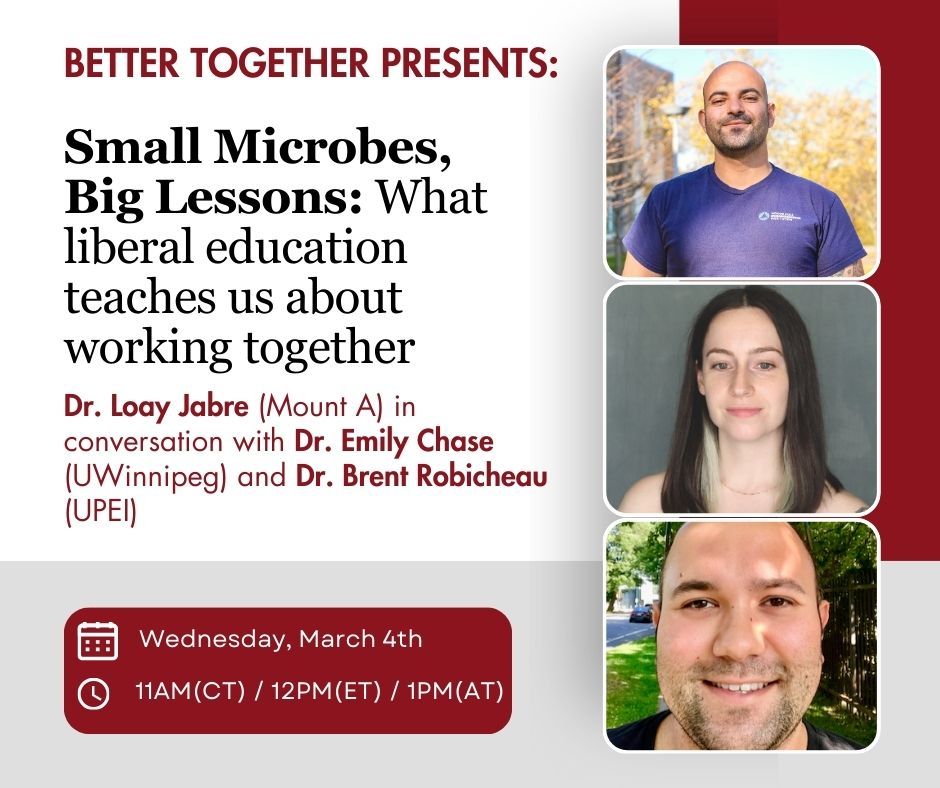
The Maple League Teaching and Learning Committee warmly invites you to our Better Together event: Small Microbes, Big Lessons: What liberal education teaches us about working together with Dr. Loay Jabre (Mount Allison University) in conversation with Dr. Emily Chase (University of Winnipeg) and Dr. Brent Robicheau (University of Prince Edward Island)
When: Wednesday, Mar 4, 1:00-2:00pm(AT)
Where: Live on Zoom – Register here
Aquatic microbes are among the most abundant and functionally diverse organisms on our planet. They perform various essential Earth-system functions, such as underpinning marine food webs and fisheries, and helping regulate our climate.
In this session, three aquatic microbiologists recently hired in tenure-track positions across Canadian institutions reflect on the paths that brought them there. Having trained early in their careers at the same small liberal arts university, they draw on curiosity-driven learning, interdisciplinary thinking, and community-centered values. They will share how their liberal arts educational foundations influenced their professional growth over the years, and how it shaped their scientific identities, research programs, and approaches to mentorship and collaboration.
Dr. Emily Chase is an Assistant Professor at the University of Winnipeg, Manitoba whose primary focuses are virologist and phycology. Her BSc Honours research and MSc was accomplished at Acadia University, Nova Scotia, and her PhD at the Aix Marseille Université as a Marie Skłodowska-Curie/DOC2AMU scholar. Her education was followed up with a three-year Postdoctoral Research position at the University of Tennessee Knoxville, Tennessee. Her team is currently exploring the virus and microalgae host dynamics in Lake Winnipeg through temporal and spatial sampling of the lake system. Her team is motivated to study Lake Winnipeg given that it routinely houses algal blooms – both harmful ones and one that are a part of the normal lake ecology. Some of her past environmental work includes studies of microbes in the Mediterranean Sea, great lakes of Kenya, China, and Lake Erie. She currently holds an NSERC Discovery Grant for her Lake Winnipeg research, and is a Reviewing Editor for ASM Microbiology Spectrum.
Dr. Loay Jabre is an Assistant Professor of Microbiology at Mount Allison University where he teaches various microbiology courses. His lab studies molecular processes within marine microbial cells, and how these processes influence large scale biogeochemical systems. Prior to joining Mount Allison, Dr. Jabre completed a BSc(hons) at Acadia University, MSc and PhD at Dalhousie University, and conducted postdoctoral research at the Woods Hole Oceanographic Institution in Massachusetts, USA. When not in the lab or on oceanographic expeditions, he enjoys cooking and foraging for mushrooms.
Dr. Brent Robicheau is an Assistant Professor of Biology at University of Prince Edward Island (UPEI). His research focuses mainly on environmental microbiology, while also teaching multiple undergraduate microbiology courses. Prior to joining UPEI, Dr. Robicheau earned a BScH and MSc in Biology from Acadia University, and then a PhD at Dalhousie University. More recently, Dr. Robicheau held an NSERC Postdoctoral Fellowship at Clark University (Massachusetts, USA), where he worked alongside other researchers in Rhode Island to investigate host-viral interactions in estuarine systems. Broadly, his research aims to deepen our understanding of the ecology and genomics of microbes in the marine realm.