

Acadia Research Featured in State of The World's Plants and Fungi Report
As the Arctic warms, its plants are changing, and Dr. Zoe Panchen is paying close attention.
Dr. Panchen, an Assistant Professor of Biology at Acadia University, uses digitized herbarium specimens to study how plants are responding to climate change.
Three of her papers are featured in this year's State of the World's Plants and Fungi report, produced by the Royal Botanic Gardens, Kew—one of the world's leading authorities on plant science.
The report, published for the sixth time since 2016, makes technical scientific research accessible to a general audience. This year, it notes that 40 percent of plant species worldwide are threatened with extinction.
Dr. Panchen’s work appears in the report's section on phenology, the study of how seasonal and climate patterns shape recurring events in nature, such as when a flower blooms or a bird migrates.
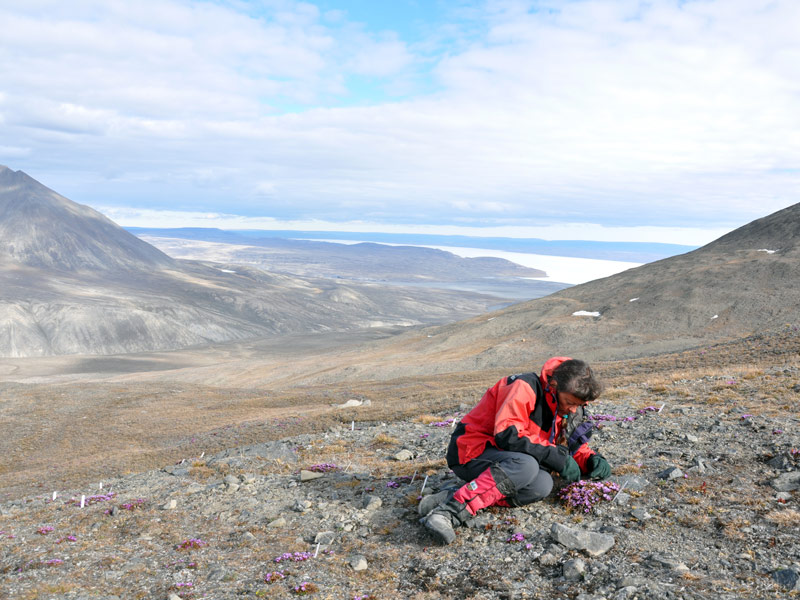
Arctic plants are blooming earlier, and their window is shrinking
One study, conducted by Dr. Panchen during her postdoctoral research at the Canadian Museum of Nature in Ottawa, found that Arctic plants are flowering earlier and experiencing a shorter overall flowering season.
"Flowering times are very dependent on temperature," Dr. Panchen explains. "In the Arctic, temperatures are warming the most towards the end of the growing season and over the winter."
She says that’s making the window for plant flowering smaller because late-flowering species are blooming earlier than usual.
This matters because if plants can't respond to climate change, they may face a greater risk of extinction.
“If a species is flowering super late, it might miss its window of best opportunity (for reproduction),” Dr. Panchen notes.
Old specimens, new insights
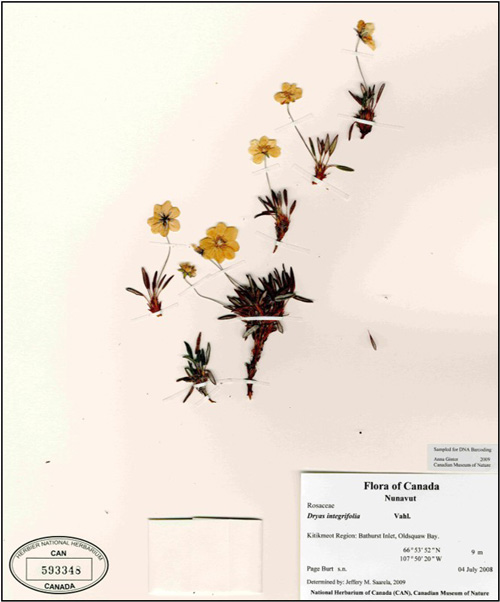 Dr. Panchen’s research is based on an innovative data source: herbarium specimens—plants that have been dried, pressed, and archived, in some cases for more than 100 years.
Traditionally used to identify plant species, these collections are now revealing long-term patterns in how plants grow and when they flower.
“You can build a time series of when that species was in flower over a long period of time,” Dr. Panchen says. “It’s similar to looking at the rings on a tree to see how much it grows each year.”
For the second study included in the Kew report, Dr. Panchen and her Acadia students analyzed scanned images from global databases to measure the annual growth in Arctic shrub specimens.
They used the data to build plant growth timelines stretching back over a century.
“We could recognize where growth started in a particular year and add it to determine how much the plant grew each year,” Dr. Panchen explains.
Taya Lucas-Desmond (‘25) is one of the students who worked on Dr. Panchen’s research team as part of her Honours studies in Environmental Science.
Lucas-Desmond says she worked mostly with physical specimens from Acadia’s E.C. Smith Herbarium—the largest of its kind in Atlantic Canada.
“The herbarium does a good job of recording dates, locations and other important information,” Lucas-Desmond says. “So I was able to build a large dataset—for example, seeing that a species was in flower in June in the 1960s, but is now in flower in May, and asking what that means for us today.”
Lucas-Desmond also used some digitized specimens in the research and noted that an advantage to those was that she could zoom in to get a clearer look at whether it was a flower or fruit.
She adds that she also included more recent data points from iNaturalist, a social network for naturalists that provides citizen science observations to capture more recent flowering times.
Herbarium science meets AI
The third featured paper reviews how researchers worldwide use these online herbarium databases for large-scale phenological research, making the case for their growing value.
Digitized herbarium specimens made Dr. Panchen’s current research possible because she and her team didn’t have to travel to examine them in person.
“We used to just take a physical herbarium specimen and look at it,” Dr. Panchen notes. “Now we have huge databases like the Global Biodiversity Information System, where people have scanned the images and record all the data associated with it.”
The initial studies involved a team of researchers examining specimens. Going forward, Dr. Panchen sees an opportunity to scale up the work by using technology to automate analysis across far larger collections.
“Using machine learning, AI, and other techniques is definitely at the forefront of this field,” she notes. “There’s potential for doing larger studies and answering questions you wouldn’t be able to on a small subset of data from a local herbarium.”
Global research rooted in Acadia
Dr. Panchen chose Acadia in part because of its large herbarium and a botanical garden—both central to her research. She works closely with honours and graduate students in her lab who assist with her phenology research.
Lucas-Desmond says her work with Dr. Panchen has been extremely helpful in her education and post-graduation career.
“She’s been an excellent mentor,” Lucas-Desmond says. “Beyond the honours thesis itself, I developed a lot of soft skills that have really served me as a researcher: scientific writing, problem-solving, critical thinking and scientific method.”
“I also did a significant amount of coding to transform the data from Excel spreadsheets into graphs and datasets. I genuinely don’t think I would have landed any of my post-graduation positions without that experience.”
While she currently has a full lab. Dr. Panchen says she’s always on the lookout for students interested in plants, climate change, the environment and conservation. She adds that with so much information about herbarium specimens available online, she sees an opportunity for citizen science projects to further research.