

Dr. Alex Marland brings the inside of Canadian politics to Acadia
On a Friday in October, a busload of students sat in MLAs’ chairs on the floor of Nova Scotia’s House of Assembly. Earlier in the day, they visited city hall and the Lieutenant Governor’s residence, where they met the Lieutenant Governor, the Mayor of Halifax, and several MLAs.
For Dr. Alex Marland, that access is part of the lesson.
“That small-town feel that Nova Scotia politics has is much harder to replicate in bigger places,” Dr. Marland says.
Getting students inside political institutions is a big part of his work as Professor of Political Science at Acadia University.
Insider access also underpins his decades-long research into Canadian politics, much of which is built on conversations with politicians, political staff, journalists, and public servants about how things work behind the scenes.
That approach has produced award-winning research and national recognition for Dr. Marland, who is also Acadia’s inaugural Jarislowsky Chair in Trust and Political Leadership.
This month, he will be inducted as a Fellow of the Royal Society of Canada. He was previously elected to the Society’s College, which recognizes emerging scholars. Fellowship is a permanent honour for established scholars, based on research impact.
Acadia’s Dr. Emily Bremner, Professor of Kinesiology, is being inducted as a member of the College of the Royal Society the same night.
An on-the-ground view of politics

Dr. Marland’s research explores how political campaigns run, how governments communicate, and how they plan their messaging.
That work has become increasingly relevant as technology changes rapidly, communication platforms evolve, and governments face bigger risks when messages go wrong.
“I’ve been trying to explain how things work on the inside that we don’t normally see,” Marland says.
“A lot of the things that are in textbooks are very helpful, but they’re often missing a lot of nuance,” he says, “and you can only get that by talking to people who are in the game.”
His book on branding in the Government of Canada, Brand Command, won the Donner Prize in 2017 for excellence in Canadian public policy writing. His most recent book, No I in Team, on political party loyalty, won best Canadian politics book awards from both the Canadian Political Science Association and the American Political Science Association.
Marland started developing his approach as an undergraduate at Carleton University in Ottawa, where he volunteered for two MPs on Parliament Hill and in two political party offices. He later worked in the Newfoundland government and taught political science at Memorial University of Newfoundland.
In Inside the Campaign, a book he edited that pairs academic authors with politicians, Dr. Marland offers a view into the often-improvised reality of political campaigns.
His conversations with political insiders reveal a world less polished and predictable than outsiders might assume.
“It’s nowhere near as methodical and complex or well-resourced as Hollywood movies would have us think,” he says. Campaign teams often put the plane together as they fly, and “it’s usually a small little Cessna,” Marland notes. “These are not large planes in Canadian politics.”
“People on the inside must explain things.”
But getting insiders to talk isn’t always easy.
People still working in government may hesitate to speak openly for fear of career repercussions. People who have recently left are often more accessible, but their knowledge might not reflect how a current administration operates.
For example, someone who worked under former Prime Minister Justin Trudeau might have insight into how the federal government operates, but that might not reflect Prime Minister Mark Carney’s unique approach.
That can be particularly challenging for academics. Journalists can report that someone wasn’t available for comment, but politicians can easily ignore researchers.
“You can get ghosted with no repercussions,” Dr. Marland says.
He has published research on securing interviews with political elites, including his own experience building relationships and tips he’s received from journalists.
For Dr. Marland, the stakes go beyond academia. Without access to government officials, the public can be left in the dark about important aspects of political institutions.
“People on the inside must explain things,” he says, “but if we’re scared to contact them, or don’t know how, we end up living in a democracy where things are hidden from us.”
Dr. Marland’s research also informs his public commentary. As Acadia’s most-quoted voice in national media, he regularly discusses political developments across Canada.
Rather than advocate for policies or predict outcomes, he sees his role as explaining how politics works.
“I can’t tell you what’s going to happen next, but I can tell you what’s happened previously,” Dr. Marland says.
Bringing the inside of politics into the classroom
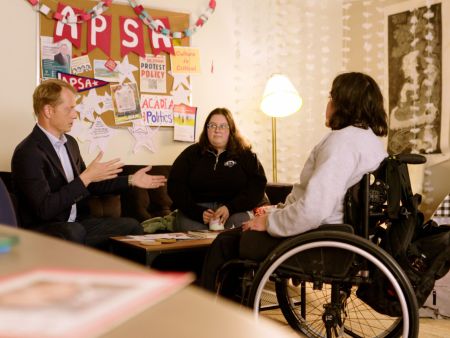
His research relationships also open up opportunities for Acadia students.
“They’ll trust me if I reach out and say, here’s something I’d like to do with students, and they realize I’m not a threat,” he says.
Beyond field trips, Dr. Marland brings politicians and political insiders into the classroom. These experiences let students hear directly from people whose work they might otherwise only come across in textbooks, news reports, or academic research.
For example: In early November, former Prime Minister Justin Trudeau’s photographer visited to explain how he works on the road. Dr. Marland has also arranged a Q&A with Yvonne Jones, former federal Parliamentary Secretary to the Minister of Northern Affairs.
Knowing firsthand just how important access to these political players is, Dr. Marland makes sure it's something that each of his students at Acadia gets.