

Episode 2: Mani’s multi-coloured marbles
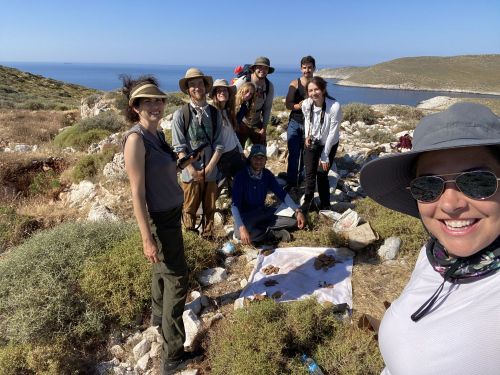
We last left our heroes (members of the Southern Mani Archeological Project—SMAP) exercising the power of interdisciplinary teamwork to uncover a rare archeological and geological phenomenon.
Last summer, in the basement of an abandoned eighteenth- or nineteenth-century house built over an eroding rock face, SMAP archeologists and geologists found pieces of rock containing pottery—also known as pottery breccia. It’s quite literally human history integrated into the geological history of Greece’s Mani Peninsula.
“It’s a stone so mysterious that we’ve never seen anything quite like it,” says Megan Earley (third year, Environmental Geoscience).
Now, a year later, Megan is joining Dr. Chelsea Gardner (History & Classics) and Dr. Mo Snyder (Earth and Environmental Science) in their return to the scene of the discovery for further exploration. This time, in addition to continuing to uncover the wonders of the pottery breccia site, bringing new samples back to their lab at Acadia, they also set out to collect samples from marble quarries in the area.
The mysterious marbles at the gates to the underworld
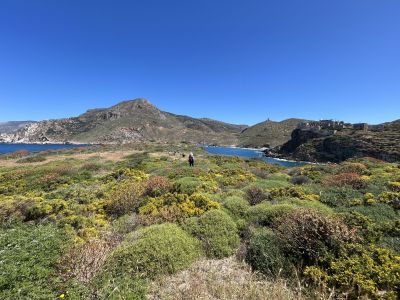
If you go digging in the right spots on the Mani Peninsula, you’ll find marble in four different colour varieties: red, green, black and white.
Culturally, the Mani marbles are significant because while they were first exploited in the Bronze age (one of the most famous buildings from the site of Mycenae, the Treasury of Atreus, has surviving pieces of the facade that are made out of this marble), the biggest flurry of mining activity happened much later in the Hellenistic to Roman periods.
“What I think it is supremely cool about the marbles is that there is an interaction in Mani between the sacred landscape (Tainaron is a very important sanctuary to Poseidon and also the mythological entrance to the Underworld) and the exploited landscape,” explains Dr. Gardner. “The increase in quarrying activity seems to happen at the same time that the religious activity at the sanctuary declines. Almost like the two can't co-exist in harmony.”
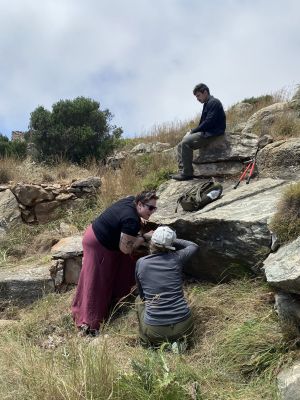
Geologically, the nature of the marbles is one of the puzzles the SMAP team is trying to solve. There are four different colours of marble within a fairly small geographical area. Were the marbles different colours originally or did they change colours way after rock formation? They aren’t sure, and that’s why Dr. Snyder says they’re doing tests.
“Greece is in a very tectonically active part of the world. There have been millions of years of plate tectonics causing multiple stages of mountain building resulting in lots of different rocks in close proximity to each other,” says Dr. Snyder. “The different coloured marbles may be original differences in composition or may be a secondary phenomenon!”
Back at the lab to see what’s on the (marble) slab
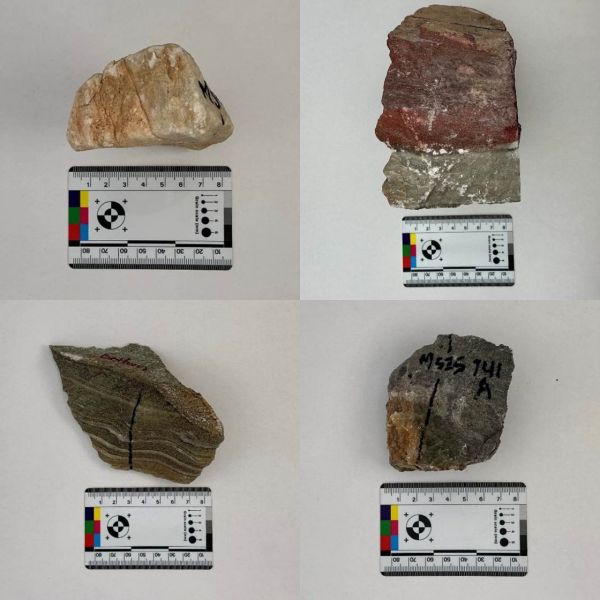
The team collected samples of red, green, black, and white marble varieties which will join those sampled last season in the Acadia Petrographic Lab. There, they will be processed into thin sections (geologic microscope slides) and polish-faced hand specimens for further study.
Some of the best samples from this season will even join the batch being prepared for the archival collection at the Field Museum in Chicago, Illinois! The partnership between the two institutions—which will provide plenty of exciting research opportunities for Acadia students and faculty—emerged from the co-direction of the SMAP project under Acadia’s Dr. Gardner and the Field Museum’s Dr. Bill Parkinson. Dr. Gardner also acts as a research associate at the Field Museum.
“For our thin sections to find a home in the Field Museum collection feels akin to an artist having their paintings displayed in the Louvre," says Megan.
She’s hopeful that researchers near and far will be able to use the Mani marbles for applications like artifact sourcing, trade tracking, and geological mapping. This research will help us better understand how far-travelled and prestigious the Mani marbles were throughout the ancient Mediterranean trade networks, painting a clearer picture of ancient Greek life.