

Formula for change: Student researchers bridge infant feeding crisis stories and policy
 In 2022, a contamination-linked shutdown at a major infant formula plant set off a cascading shortage, leaving shelves across Canada and the United States bare, and available options skyrocketing in price. Thousands of families went to desperate lengths to feed their newborns: joining Facebook groups to crowdsource tips about restocked shelves, driving across borders for a single can, and relying on donated breast milk from strangers just to get through the week.
Although formula production eventually resumed, the crisis revealed the fragility of “first-food systems” (those that feed the youngest in our society). Many caregivers who use formula, both exclusively and to supplement breastfeeding, continue to navigate uncertainty and rising costs.
Their stories and more are featured in Finding Formula: Confronting Insecurities, a major research project headed by Acadia University’s Dr. Lesley Frank, a Tier II Canada Research Chair in Food, Health and Social Justice, sociology professor, and director of the Fed Family Lab. This initiative, along with her two decades co-authoring the Nova Scotia Child and Family Poverty Report Card, is part of her life’s mission to connect research directly to those positioned to act. Finding Formula is supported by an interdisciplinary team, including Acadia University co-investigators Dr. Elisabeth Rondinelli (Sociology) and Dr. Jane Francis (Nutrition and Dietetics), both Research Affiliates with the Fed Family Lab — reflecting the lab’s mandate to bridge faculties in addressing complex social issues.
“This kind of research equips decisionmakers with a deeper understanding of the problems faced in our society,” says Dr. Frank. “That knowledge is crucial for crafting effective policies and solutions that impact people’s lives.”
Supported by a SSHRC Insight Grant, Finding Formula uses both hard survey data and digital storytelling to convey the lived realities behind infant food insecurities, helping the public, institutions, and policymakers see what statistics sometimes fail to capture.
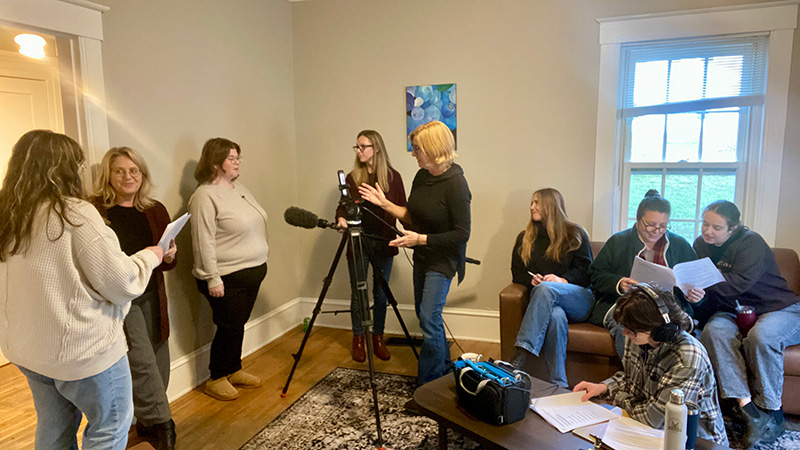
To carry out the work, Dr. Frank enlisted 13 Acadia student research assistants (RAs) from multiple disciplines—along with project coordinator Alyssa Gerhardt (PhD Candidate and Acadia Alumni), an ASL interpreter, documentary filmmaker Ariella Pahlke, Dr. David Szanto as website designer, and a collaboration with Halifax’s Polaris Choir. The move not only gave students a rare real-world research experience and opportunities for creative practice, but also helped to shape the project’s trajectory.
“Students are the bridge between academic inquiry and public understanding—and that’s where research can change the world,” Dr. Frank says. “They have the tools to translate findings for real audiences. By demonstrating those insights, these RAs teach me as much as I teach them.”
How shortages meet storytelling
 Finding Formula explores what caregivers experienced, thought about, and how they coped with shortages and financial constraints when feeding their infants, and how institutional relations either complicated or supported their daily lives.
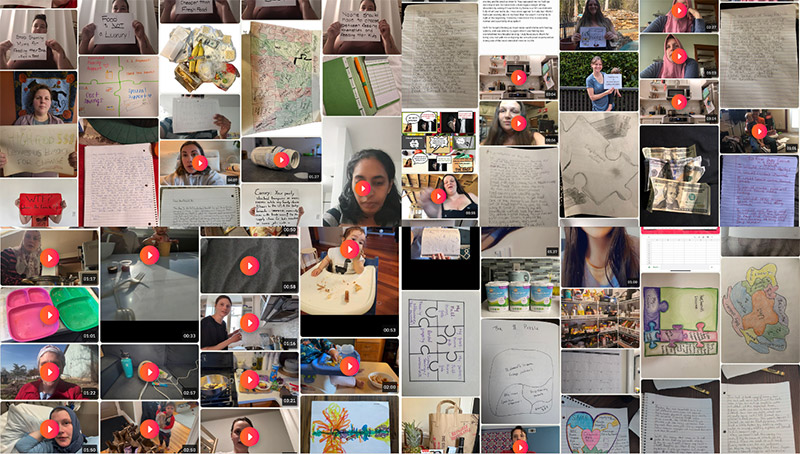
From an initial group of mothers who created Facebook groups to help families locate infant formula during shortages in Canada and the United States, the research grew to include a survey reaching 918 respondents. Of those, 300 expressed interest in participating more deeply, and ultimately 47 caregivers from seven provinces, one territory, and 14 U.S. states took part in a digital ethnography, sharing their experiences in English, French, Spanish, and ASL.
Videos, journal entries, and artwork were analysed, curated, and produced by the RAs to relay everyday infant feeding experiences along with emergency measures taken on by families.
While the survey data laid the foundation of Finding Formula, storytelling became the heart of the project.
As Dr. Frank explains, storytelling “lets the evidence breathe. It links data to real understanding, making visible the labour, emotions, and everyday negotiations inside feeding work in ways numbers alone can’t.”
A powerful real-world experience for student researchers
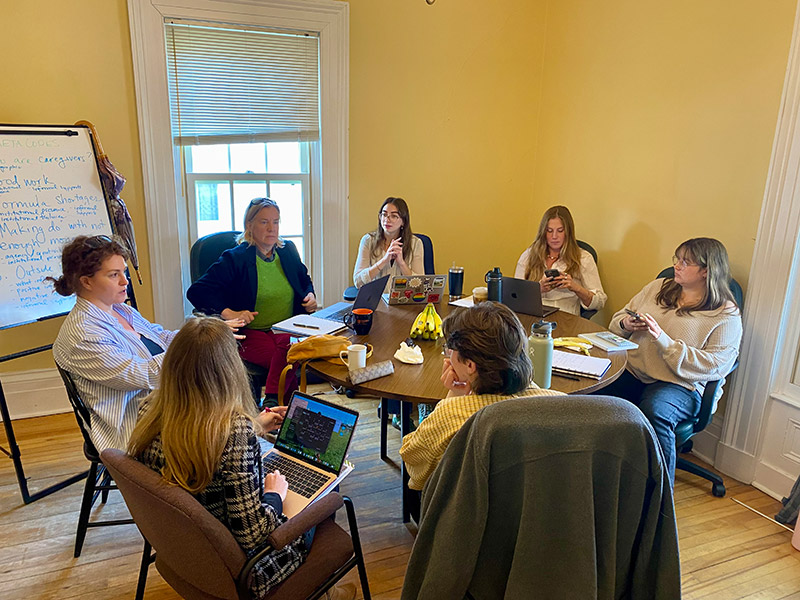 The Acadia student RAs who helped make this happen represented interdisciplinary backgrounds, and included those majoring in sociology, politics, English, theatre, psychology, women’s and gender studies, and law and society. Each RA applied distinct skills to the research and to the art of translating data into empathy.
Ruby Harrington, who recently defended her MA in politics, was one of the first RAs on the project. Her early work focused on developing the study’s research tools and overseeing incoming data, and the experience went on to inform her successful master’s thesis.
She was struck by the emotional weight of the stories. “I wasn’t expecting to be so impacted by the rawness of people’s experiences,” she says. “These were real-time reflections from people navigating stress, fear, and sometimes guilt, and it made clear how important this work was.”
For Ruby, the storytelling approach showed the complexity and human costs of the shortages. Reflecting on the story of a mother who drove to five stores before work, only to end up crying in a parking lot because every shelf was empty, she says, “You can see the worry on a mother’s face, hear the crack in her voice, and feel what she’s feeling. You can’t treat that as abstract data.”
Nick Lundrigan, an Honours student in English and women’s and gender studies, joined the project as it moved into building its visual components. Their work centred on shaping participant videos into concise, powerful narrative pieces. Nick recalls how emotionally challenging it was to handle such vulnerable footage. “Seeing parents document their days — the panic when the shelf was empty, the joy when a friend dropped off a can — it showed how high the stakes were,” they explain.
One moment that stayed with Nick involved a participant who talked about feeling like a failure for not being able to breastfeed. “It was heartbreaking,” Nick says. “And it made me want to make sure her story came through just as she told it.”
Honours student Brit Pulsifer Hiltz, who is double majoring in sociology and law and society, supported the project through coding, thematic analysis, and building narrative summaries within the Fed Family Lab’s collaborative writing process. What resonated most was how clearly participants’ stories illuminated the “labour” of feeding. “People often talk about feeding as a natural act,” she says, “but the diaries show how much work, emotion, and strategy goes into it, especially when systems are strained or failing.”
Brit valued how the project created a space for honouring these rarely seen forms of care. “It isn’t just data,” she notes. “It’s lived labour, and storytelling helps us respect that.”
For Sara Farguson, a fourth-year Honours English student, transforming the diary submissions into written vignettes for the website meant condensing weeks of detailed entries into short, accessible stories while protecting the integrity of each parent’s voice. “I spent a lot of time trying to maintain both the emotional truth and the narrative flow,” she explains. She remembers one particular storyinvolving a mother who had no private, sanitary space to pump breast milk at work. “It showed me how policy gaps don’t just inconvenience parents—they create tangible harm,” Sara says.
The team’s weekly meetings, where everyone compared notes and interpretations, became what Sara calls “a classroom of shared discovery.”
Her colleagues agree. “It showed me what a liberal arts education can do when it connects disciplines,” says Ruby. “This wasn’t just research; it was understanding people’s lives in a way I’ll carry forward.”
“Sociology, politics, gender studies, English — we all brought different lenses, and it made the story stronger,” confirms Brit. “Being trusted to work so closely with people’s lived experiences was the most meaningful part of my degree so far.”
From insight to action: What happens next
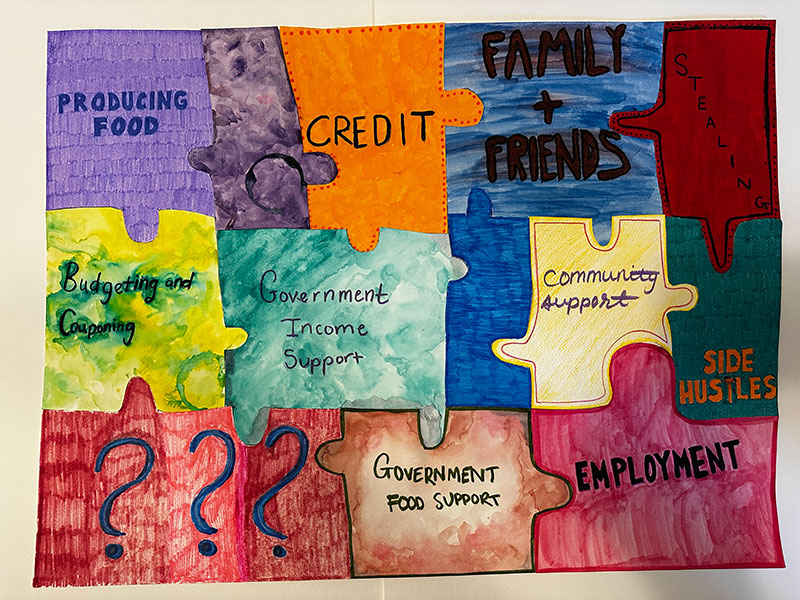 While Finding Formula documents stories of frustration, fear, and resourcefulness in the face of institutional gaps, the project is ultimately about impact. Fed Family Lab’s broader mission is to connect the data to social policy around food and caregiving in order to help put sustainable solutions in place.
Dr. Frank and the team are now sharing Finding Formula with federal and provincial policymakers, healthcare organizations, and professional associations — from Health Canada and the FDA to hospital lactation consultants.
“By listening to caregivers’ stories, we start to imagine policies rooted in empathy, dignity, and justice,” says the Acadia University professor. “Our participants raise specific and actionable ways to improve food security for young families, and those insights need to be heard.”
What might those insights look like in practice?
At a national level, the findings highlight the importance of strengthening Made-in-Canada formula production through faster regulatory pathways and recognizing infant formula as an essential good, so families are not left vulnerable to price spikes. Income policies could also be updated to better reflect the real labour and costs of infant feeding, including accessible maternity and parental leave, adequate income replacement, and child benefits that meaningfully assist families in the early months.
Closer to home, participants’ experiences indicate opportunities for improvement at points of care. Chief among these needs are stronger community-based lactation services and non-commercial pathways to formula access. Specifically, these programs need to be designed to recognize the mental health toll of feeding pressure while aiming to ease the burden of parents becoming crisis managers early in their child’s life.
For Dr. Frank’s student researchers, the work underscored a clear hope: that Finding Formula would lead to meaningful change. “The stories show how much families do on their own when systems fail them,” Brit adds. “The project really highlighted for me how important it is for policy to meet parents where they actually are, not where we assume they are.”
Nick agrees: “It’s easy to ignore numbers. It’s harder to ignore a parent speaking directly into the camera.”
For Ruby, the impact is clear: “These stories matter. They show the human consequences of policy decisions — or lack thereof. My hope is that people in power really hear them.”
And for Sara: “I want these stories to create change. That’s why people shared them.”
The public is also invited to engage with the project. All stories, vignettes, and videos will be available on the Finding Formula website, offering caregivers, advocates, and community groups a chance to explore the work firsthand.
Learn More