

Tagged Atlantic bluefin tuna tell story of species’ recovery
Atlantic bluefin tuna populations were headed for collapse because of overfishing in the early 2000s. In recent years, the species has rebounded, and a new report on the decades-long electronic-tagging program reveals why.
Acadia University is the Canadian research partner in a 30-year international program to tag and study the movement of Atlantic bluefin tuna. This largest of the tuna species can grow to more than 700 kilos (1,500+ pounds) and is prized commercially and by sport fishers.
“This is a good news story and a program that shows the value of international collaboration,” says Dr. Mike Stokesbury, who is leading the Canadian research. Dr. Stokesbury is Director of the Acadia Centre for Estuarine Research and a professor in the Biology Department.
The program is led by Dr. Barbara Block of Stanford University and includes partners in Norway, Sweden, Ireland, Spain and the UK. Acadia and Stanford are the two academic institutions involved in the Canadian tagging. Local fishers – including Captains Dennis Cameron and Kenny Chisholm – and Canada’s Department of Fisheries and Oceans are also important partners.
Strict North American catch limits have enabled the smaller western population (which spawns in the Gulf of Mexico) to recover. Bluefin from the larger Mediterranean Sea population migrate from eastern areas with higher catch limits into the safer waters of the western North Atlantic to forage before returning to the Mediterranean to spawn. The lower catch limits in the west have, therefore, in part, enabled the Mediterranean population to recover as well.
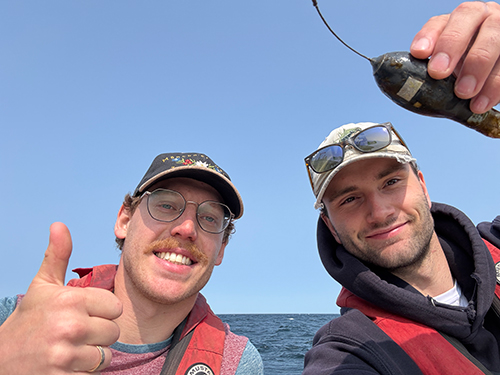
Students Benjamin Henger (left) and Bowen Stokesbury-Price hold a pop-up satellite archival tag. The tags detach from tuna and report to satellites. Researchers always try to recover the tags, because they provide useful raw data.
Stokesbury has been working with Dr. Block on bluefin since 2000. The current study began tagging fish in Canadian waters in 2005 as part of the Tag-a-Giant program, whose research is intended to help ensure a future for wild bluefin tuna.
Teams in North America and Europe worked with commercial fishers to deploy more than 1,700 electronic tags over the years. The bluefin were caught one at a time, brought aboard, irrigated to keep them calm, tagged, and released.
“The bluefin tuna fishers we work with here in Canada are fantastic,” Stokesbury says. “They’re conscientious, they’re conservation-based, they’re professional fisherman, and they are the backbone of the program.
“The best place to tag the fish we’re studying is Canada. Tuna are endothermic (they retain metabolic heat), so mostly large fish come into Canadian waters before they move to their spawning grounds.”
The project has been amazing for Acadia students, Stokesbury adds. “Over the years, 24 Acadia students have worked in the program. They get to work on commercial fishing boats, assist in tagging giant bluefin, and make connections with international researchers. Basically, they play a key role in conservation-based, world-class science.”
Read more:
“Tagged tunas reveal keys to Atlantic bluefin recovery” – Stanford University
“Western Atlantic acts as refuge for recovering bluefin tuna” – National Fisherman magazine
“Collaborative Study Shows the Western Atlantic Provides Refuge for Bluefin Tuna” – ECO magazine