

From climate change to nursing, Zabrina Whitman centres Indigenous ways of knowing
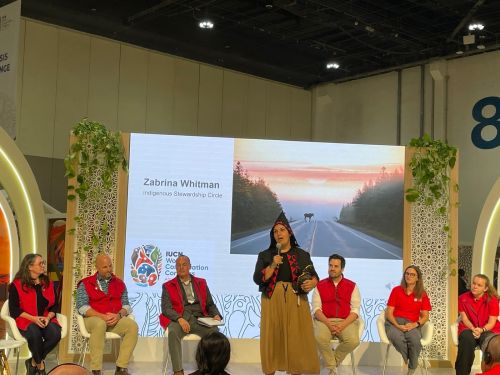
When Zabrina Whitman attended the International Union for Conservation of Nature (IUCN) World Conservation Congress in Abu Dhabi, she noticed that the way experts spoke about the climate crisis had shifted.
For the first time in her decades-long career as a policymaker and advocate, she heard many of the 10,000 conference attendees acknowledge and centre Indigenous solutions to the world's greatest problem.
While we’ve known that the Earth is in trouble for some time, scientists and policymakers have looked to western ideas to solve the crisis. But “progress” and capitalism got us into this mess, and it won’t get us out of it.
“Understanding Indigenous ways of knowing and being and how we’re all interconnected creates solutions for addressing climate change. It’s the understanding that our actions have impact on all of those around us, human and non-human,” Zabrina explains.
“Solutions for climate have to truly understand and value Indigenous knowledge systems. We know the work that needs to be done to protect environment and to protect ecosystems, so the biggest piece of what allies can do is support us in our expertise.”
Indigenous Stewardship, from Mi'kma'ki to Abu Dhabi
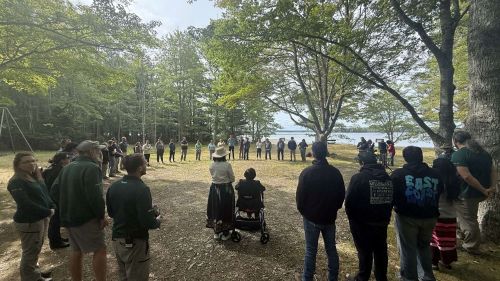
Indigenous ways of knowing offer an essential framework for healing — whether that’s the climate, personal relationships, or relationships between governments, land, and the people who inhabit it.
This is the basis for all of Zabrina’s work, whether she’s on the world stage talking about climate change, or supporting curriculum development in Acadia’s new nursing program. And it's what brought her to Abu Dhabi for the IUCN Congress. As Vice Chair of Parks Canada’s Indigenous Stewardship Circle, she presented on three panels about Indigenous stewardship and conservation.
The Stewardship Circle operates with the philosophy Zabrina saw reflected at the IUCN conference: as stewards of lands, water and ice since time immemorial, Indigenous peoples hold the knowledge of how best to care for the Earth. The Circle’s work is to guide Parks Canada’s relationships with Indigenous partners from coast, to coast, to coast, on everything from HR policy to formal negotiations.
In 2025, the Stewardship Circle developed and released a new Indigenous Stewardship Policy for Parks Canada, which earned them a nomination for the Parks Canada's CEO’s Award of Excellence. The awards recognize achievement, innovation and leadership in Parks.
Zabrina says that the policy is more than just meaningful for Parks Canada. “It’s an example to any federal department of how they can implement the UN Declaration on the Rights of Indigenous Peoples Act (DRIPA).”
“It’s all that relationship piece”
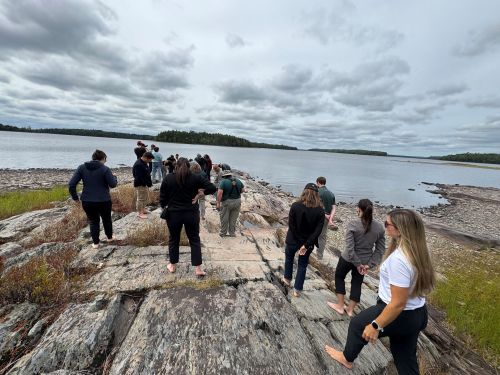
“The values and the principles within the policy itself are a guiding document for how to have relationships between people. It’s in the context of Indigenous and non-Indigenous relationships for Parks Canada, but the language in it is adaptable to any type of relationship that exists,” says Zabrina.
Essentially, the policy focuses on building relationships between Indigenous peoples and partners and facilitating conversations between people. And so does Zabrina’s work at Acadia. In her role as Executive Advisor of L'nu Affairs and Indigenization, she leads with an emphasis on relationship- and trust-building.
“In any work that I do with individuals, nations, partners across the country, it’s all that relationship piece,” she explains.
Better people, better nurses
The project at Acadia that she’s most excited about bringing her relationship-forward philosophy to is the co-creation of a curriculum for Acadia’s new School of Nursing with Tajikeimɨk, an organization leading the transformation of health and wellness for Mi’kmaw communities in Nova Scotia.
“That’s the thing I get most excited about in my work at Acadia: everything I do is grounded in Mi’kmaw values and relationship building,” she explains.
The program will be entirely unique in Canada in that it is built upon cultural safety and humility, Indigenous ways of knowing, and a grounding in the Truth and Reconciliation’s Calls to Action.
While grounded in Mi’kmaq philosophy, the program is for all students who want to come into a nursing program and leave as a good nurse and a good person.
“We want them to have the capacity that when they work with any person they are treating them as a human being and respecting different cultural and historical backgrounds,” she explains.
“Being a good human being is one of the most important pieces, next to the clinical requirements.”
“These are not small things”
This work of leading with compassion and trust—and bringing others along on the journey—can be challenging, but for Zabrina it’s all worth it. Whether it's leading conversations around solutions to the climate crisis, or ushering in a new generation of compassionate nurses, Zabrina puts her heart fully into the work.
"The stuff that I get to work on are the things I’m passionate about and tickle my heart. Some of it can be super heavy but when implemented it can make significant change. These are not small things, they make an incredible difference to peoples’ lives. That kind of work excites me."