

Rooted in Community: Acadia student helps grow food security on Nova Scotia's Eastern Shore
If you've been to the grocery store lately, you’ve likely felt the pinch. Canada's Food Price Report 2026 confirms it: food costs 27% more than it did five years ago, with Nova Scotians expected to see above-average increases this year.
This has understandably led some to search for practical ways to get by and regain a sense of control. On Nova Scotia's Eastern Shore, a small group of volunteers was already working on how to help neighbours start their own food gardens. This year, an Acadia University student named Robyn Dearman helped them find the land to do it.
The Sea Spray Garden Initiative, a new not-for-profit, is building a network of gardeners and workshops, with plans for a community market garden.
A placement that shifted a vision
Robyn is finishing her Bachelor in Community Development at Acadia and graduating this May. Her final term included a nine-week professional placement with Sea Spray, and she arrived there almost by accident.
“I was invited to what I thought was a garden club meeting, but it turned out to be a group starting a community initiative,” Robyn says. The original plan centred on in-home support for vulnerable individuals. “I knew of a piece of land that was already set up for a community garden and just hadn't taken off. I suggested coming on board for my placement and helping move that piece forward.”
She did — and helping to secure the land shifted everything. The initiative pivoted to focus more on food security, with education happening on-site.
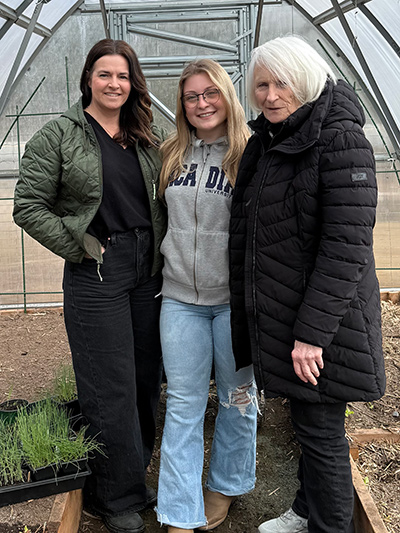
From left: Sea Spray Garden Initiative Board Chair Tracy Milsom, Acadia student Robyn Dearman, and Board Vice-Chair Tracey Smyth.
More than a garden
Sea Spray describes itself as “a dedicated group of experienced gardeners and other professionals.” Their mission is to use gardening as a tool for food security, mental health, and community connection.
Board Chair Tracy Milsom is passionate about why.
“I personally feel that the divide and disconnection between people have become cavernous,” Tracy says. “We spend too much time alone. We are deeply embedded in unhealthy technology. Our diets are failing us.”
Her vision for what a garden can do is both modest and expansive: “We want people to make eye contact across a row of heirloom tomatoes and see a shared mission and one another's humanity. We are far more alike than we are different.”
The need, Tracy says, is particularly acute in rural Nova Scotia. “Rural communities are more affected by food insecurity than urban centres. Transportation costs, distance to food resources, and fewer local farm markets are all contributing factors on the Eastern Shore.”
From classroom to community
Robyn's weeks have been varied: creating posters and social media content, reaching out to community members and potential partners, grant applications, program design, and “a lot of communication and coordination behind the scenes, trying to connect people, build relationships, and keep things moving forward.”
While the fundraising aspect has been challenging (“A lesson in patience and persistence!”), Robyn says the best part of her placement came when the vision stopped feeling abstract.
“There was a moment where it shifted from being an idea to something real. You could see that this will become a space where food is grown and shared, and where we can support things like local food banks, community fridges, and even offer affordable produce boxes. That moment stuck with me.”
Robyn's faculty supervisor is Dr. Gabrielle Donnelly, Associate Professor in Community Development at Acadia, who describes her role as relational rather than directive: a coach and sounding board through the challenges of real-world work.
“These placements take place in the final term of the program, and they often become a bridge,” Dr. Donnelly says. “A bridge between classroom learning and the complexity of real-world practice, and between who students have been and who they are becoming.”
In Robyn's case, Dr. Donnelly says the clarity came early. “She never looked to me to make decisions for her. She took real leadership in shaping her placement, advocating for what mattered to her, and ultimately finding her way to the Sea Spray Garden Initiative because it aligned so strongly with her values.”
“Gabrielle has been amazing,” says Robyn. “She has given me space to take initiative while always being supportive. I have felt really trusted in my role.”
That trust extended to the Sea Spray board, too. Tracy notes they never treated Robyn “like she is young nor incapable. The trust was there from the get go, and I think it went a long way toward bolstering her confidence too.” Would they welcome another Acadia student? “Absolutely.”
For Robyn, the placement has crystallised what she'd been studying. “It's everything I have been learning from first year until now, just applied in a real-world setting. It has shown me how much relationship-building, adaptability, and patience it takes. It's made everything feel more real and has strengthened my passion for community development.”
What’s taking root
Robyn's placement ends April 27, the same day Sea Spray is running a free Seed Starting for Beginners workshop at the Musquodoboit Harbour Public Library. A fitting bookend, but Robyn's story with Sea Spray is far from over.
“I am excited to graduate,” Robyn says, “but it does not really feel like an ending. More like a transition.”
In fact, Robyn plans to stay connected to Sea Spray to develop and lead youth programs that frame gardening as a life skill, partnering with community organizations such as 4-H and Beaver Scouts. Call it planting seeds for the next generation.
For Nova Scotians staring down another grocery bill, the answer Robyn helped build is an old one, made new: start small, grow something, do it together.
And if you happen to make eye contact across a row of heirloom tomatoes, that may be half the point.
Want to grow your own food? Start here.
Sea Spray Garden Initiative is hosting a free Seed Starting for Beginners workshop. Learn what seeds to choose, how to start them successfully, and how to actually keep them alive.
Monday, April 27, 2026 | 11:00am – 12:00pm
Musquodoboit Harbour Public Library
Free admission. Call 902-889-2227 to register.