

Heard it through the grapevine: Acadia students getting published
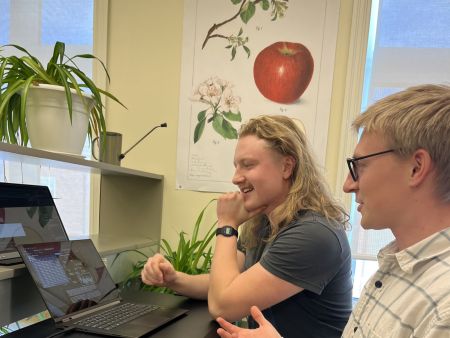
Sammy Stockdale (Biology, ‘25; MSc candidate) and Claire Dinn (Computer Science) never expected to be published authors before finishing their undergrad degrees. But when they enrolled in Dr. Zoë Migicovsky’s (Biology) Bioinformatics class in Winter 2025, they set off on a path towards their first publication in a scientific journal.
This winter their names appeared—along with their 14 other classmates—as authors on “Genomic structure and ex situ conservation of the North American grapevine Vitis labrusca” published in Plants, People, Planet.
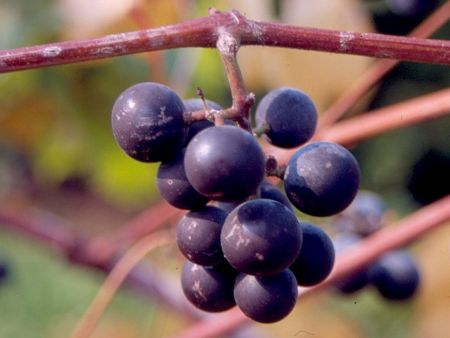
The class is cross listed between Computer Science and Biology. The students worked with real, unpublished genetic data collected from both wild and conserved Vitis labrusca grapevines, a species native to North America. This wild grapevine species contains traits that are important for disease resistance and climate resilience: traits that will be crucial in breeding resilient grapes in the future of our changing world.
Throughout the course, the students learned and applied bioinformatic tools, a field which uses computational tools to analyze genomic data, to examine genetic data from over 300 different individual grapevines.
Ultimately, the students discovered that there were gaps in conservation of the species; some individuals labeled as Vitis labrusca were actually hybrids with other species, and some genetically distinct populations were not conserved at all.The project gave students a chance to see how their skills and knowledge gained in both the biology and computer science classrooms could be applied to solve real problems beyond their education, and to see how those two disciplines can work together.
Dr. Migicovsky shared, “The work that the students did has important consequences for plant conservation and will make a real-world impact when prioritizing future sampling for conservation of Vitis labrusca. However, the techniques students learned in class are broadly used across many different research areas, and I’m excited to see how they might apply them in their future education and careers.”
Claire says that she “loved being able to apply computer science concepts to real world applications through research and uncover meaningful insights.” As for Sammy, who was an undergraduate student in Biology at the time, she says the experience opened her eyes to new possibilities.
“It encouraged me to explore research areas I can carry with me beyond my master’s degree.”
While the end result of a publication credit is a nice feather in their caps, the students took away some important life lessons on the journey. For Claire, the experience encouraged her to go into new opportunities without preconceived expectations. “My biggest takeaway is to approach everything with curiosity, an open mind, and an interdisciplinary team,” she reflects.
“This was one of my favourite classes I’ve taken,” says Sammy. “Learning in such a hands-on and research-driven way made this an engaging and memorable experience.”