

New Computing Cluster to Model Tidal Energy Turbines
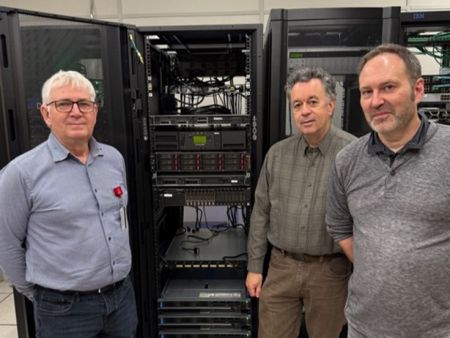
The $2.6M NRCan-funded project on tidal energy project led by Dr. Anna Redden (Biology) got a computing boost last week.
A team of experts from various departments at Acadia and abroad completed installation work on the marine renewable energy computing cluster at Acadia University . A computing cluster is a group of computers that work as a single high-performance system to tackle complex problems. This particular cluster, named Kelvin after one of the pioneers of modern physics, will allow researchers to model the strong currents in the Bay of Fundy and tidal turbines placed within it.
Dr. Angus Creech (Math and Statistics), a senior research scientist at Acadia and co-lead on the tidal energy project, identified the need for the cluster early on in the process. He worked closely with Acadia Information Technology and equipment supplier IMP Solutions to design, procure and build a cluster that was both powerful and secure. “The support provided by Gary Meister, Jacques Gouws, Donald Teed and Daniel Oikle in IT was absolutely vital in getting the cluster up and running. It couldn’t have happened without them,” says Dr. Creech.
The cluster will be able to run detailed computer simulations of the FORCE tidal energy test site and tidal turbines such as Orbital Marine’s O2-X device. This, together with related modelling by fellow project co-lead Dr. Richard Karsten (Math and Statistics), will further the team’s understanding of how marine wildlife interacts with tidal energy devices and address the engineering concerns of tidal energy developers wishing to deploy turbines in the Bay of Fundy.
Adrian Jackson, a long-term collaborator of Dr. Creech and Professor of High Performance Computing Technologies at EPCC, University of Edinburgh provided additional assistance.