

S.M.I.L.E. Thrives in Every Environment: Taking Physical Activity to the Ice and Beyond
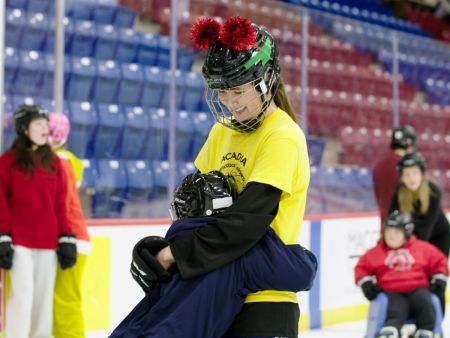
Acadia University’s S.M.I.L.E. program has built its reputation on one core idea for more than four decades: physical activity can transform lives.
Since its beginnings in 1982, S.M.I.L.E.® (Sensory Motor Instructional Leadership Experience) has grown into a uniquely Acadia experience in which student volunteers from every academic discipline work alongside participants with diverse abilities, building relationships and learning together through movement.
It’s so tied to the Acadia experience, in fact, that one in ten Acadia students volunteer with the program.
As the program changes with the times, what has become increasingly clear to S.M.I.L.E.’s directors, Dr. Roxanne Seaman and Dr. Emily Bremer (Kinesiology), is that environment matters. And this year, a major shift in programming environments has opened up new possibilities for participants, volunteers, and the program directors themselves.
A New Era of On-Ice Learning
While S.M.I.L.E. has offered ice time during its Friday and Saturday programs for years, a new grant of $25,000 has allowed the school-based Tuesday and Thursday programs (in which students from local schools come to Acadia to learn through movement) to get onto the ice as well. For Dr. Seaman and Dr. Bremer, who both come from hockey backgrounds themselves, this shift to the ice in recent months has been natural, energizing, and full of potential.
“The exciting thing now is that we can be much more intentional with our on-ice programming,” says Dr. Bremer. “With access to equipment, we’re teaching skating skills, hockey skills, and para ice hockey skills. The progress some of the kids have made in just one semester has been incredible.”
Participants now spend roughly half their session skating and the other half on sleds learning para ice hockey, giving them exposure to skills they wouldn’t have otherwise had.
“Smiles everywhere”
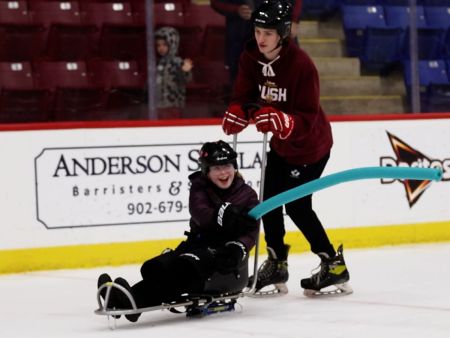
The impact of the new on-ice programming for the school-aged participants goes far beyond giving them technical skills.
“Socially, it’s huge,” Dr. Bremer says. “They come off the ice excited because they just played a game of hockey. They get to say, ‘I play hockey,’ and that’s something they might never have had the opportunity to do. In Canada, in Nova Scotia, that identity is a big part of childhood.”
“It’s really incredible,” adds Dr. Seaman. “You’ll see smiles everywhere, and they’re having so much fun.”
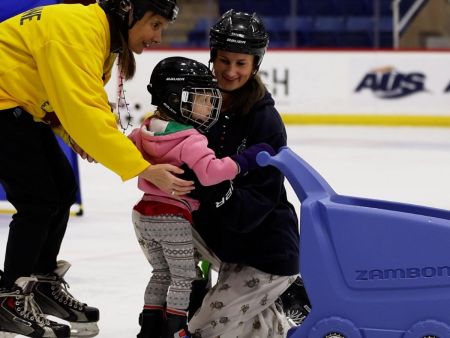
S.M.I.L.E. also ensures that cost isn’t an added barrier to this key experience of Canadian childhood. Skates, helmets, sleds, and protective gear are all provided.
“It’s an expensive sport and not everyone can afford the equipment,” says Dr. Seaman. “We’re able to make sure our participants are safe while learning to play hockey.”
From Big Leagues to First Timers, Skating is for Everyone!
While the participants are excited about new on-ice hockey opportunities, so are the program’s student volunteers. Acadia’s men’s and women’s hockey teams, the women’s ringette team, and the local skating club have long been some of S.M.I.L.E.’s strongest supporters and have taken to the new programming with gusto.
Hadley Frittenburg, a first-year Kinesiology student, S.M.I.L.E. volunteer, and athlete on Canada’s national women’s para hockey team can be found on the ice every Thursday morning coaching her participant through the maneuvers of para hockey.
“I love seeing him have fun, it makes me really happy, but it’s so much more than I expected it to be,” she says. “I’m helping him reach his goals.”
She also loves to get people excited about the sport she loves. “Every time I’m on the ice with people newer to the sport, even just teaching them the basics, I really love it. It’s amazing seeing the sport grow and see other people have the same passion I do. They’re the next generation.”
And the learning doesn’t stop at the doors of Acadia’s Athletics Complex; the next generation of para hockey athletes is getting into the community. One participant recently began attending a learn-to-skate program in Canning using a sled borrowed from S.M.I.L.E.. “We’re helping bridge the gap to community programming,” says Dr. Bremer. “They have the skills and confidence now to join activities independently.”
Expanding Environments Beyond the Ice
The success of the on-ice programming has reinforced an important lesson for S.M.I.L.E.’s leaders: varied environments open doors for participants and leaders. And that insight is driving the next evolution of S.M.I.L.E.’s reach into the digital space.
During the pandemic, S.M.I.L.E. piloted virtual programming through Zoom. That early foray into the digital realm sparked a broader research initiative, supported by a SSHRC (Social Sciences and Humanities Research Council) grant, asking youth experiencing disability what they wanted from virtual physical activity programming. Overwhelmingly, the answer was an app-based platform that blended independence, instruction, and social connection.
S.M.I.L.E. is taking that feedback and running with it. Using the architecture of Wellnify, an app developed here in Nova Scotia, they’re creating their own digital content to meet the needs identified in their research.
Students have helped develop adapted physical activity content including exercise videos, challenges, and even augmented reality components tailored specifically to S.M.I.L.E. participants. And, explains Dr. Bremer, “it can be very interactive. You can challenge your friends and have this social piece to it.”
“We’ve piloted it, built out the content, and now we’re at the point where we can expand,” says Dr. Seaman. “Our hope is to roll it out more intentionally this summer, not only to our regular S.M.I.L.E. participants but also to people in rural communities who can’t always come to Wolfville.”
Community That Moves Together
S.M.I.L.E.’s strength has always been the people behind it. The dedicated program coordinators, passionate student volunteers, alumni who return to visit, and an entire campus that rallies behind the program are what helps it flourish.
Whether gliding across the ice or challenging friends to a virtual workout at home, S.M.I.L.E. participants are learning that movement is possible anywhere. And that every environment can be one in which they thrive.