

Teaching and Learning Enhancement Awards yield outsized impact
The Teaching and Learning Enhancement Awards (TLEA) came from the office of the Provost and Vice-President, Academic to help support initiatives to enhance the quality and creativity of teaching at Acadia University. Successful projects received up to $2,500 in funding.
Here’s what the four recipients did over the past year with their projects.
ONE-DAY RETREAT INSPIRES AFRICAN-NOVA SCOTIAN YOUTH
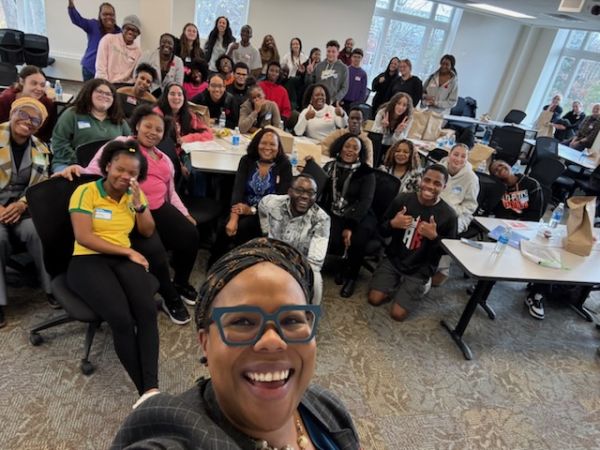
A one-day retreat at Acadia introduced high school students of African Ancestry, including Black and African Nova Scotians, to the university, and in particular to the Community Development program.
Dr. Alicia Noreiga-Mundaroy used the TLEA funding to organize and host the retreat in November 2024 with the support of all the department’s faculty members. Krishinda McBride, Coordinator of African Canadian Education Services at the Annapolis Valley Regional Centre for Education, provided help and advice.
“There is significant disparity when you look at the number of racialized students in Community Development compared to other programs,” Dr. Noreiga-Mundaroy says. “We wanted to develop connections with the African Nova Scotian community and students.”
Thirty-seven students from five local high schools attended, along with nine adults. Community Development students gave the visitors tours of the campus including their department’s classrooms and spoke about the program. The day included a series of mini-programs, lessons, activities, conversations and a catered lunch. Acadia President Dr. Jeff Hennessy as well as others including representatives of Acadia’s Equity Office and the Office of Black Student Affairs welcomed the guest students.
“The day was a success,” Dr. Noreiga-Mundaroy says. “We have achieved a small yet significant step toward establishing a connection between the Department of Community Development and high school students of African Ancestry, including Black and African Nova Scotians, within the Valley. Krishinda McBride and I have chatted about possibilities for work that we can do to collaborate.”
Dr. Noreiga-Mundaroy says that hosting another retreat for a second group of Black students would require more funding. “It would also be good to maintain and foster our relationship with the students who came here the first time,” she says.
ONLINE RESOURCE HELPS STUDENTS SHARPEN COMPUTER SKILLS
The Departments of Biology and of Mathematics and Statistics created an online resource to help students in Pure and Applied Science hone their foundational computer skills. It is designed to provide training for core skills that incoming students need to understand their computers and data-management practices, as well as to use R and RStudio software. (R is an open-source programming language for statistical computing and graphics, while RStudio provides a user-friendly interface for R.)
“Although the online resource is a living document and is still being updated, it’s being used now in about 10 courses,” says Dr. Trevor Avery, the professor steering the project. “Students say they like its accessible language and that it contains examples they can follow. They’re able to use it to repeat what they learned in class and try on their own. There is still a lot to do, but we’re working on version 2.0 now in anticipation of fall 2026.”
Paige Levangie, an analyst in Dr. Avery’s lab who received her MSc in Biology in 2025, has been the main developer and code writer on the project. They pulled information for the resource from many sources, but mainly from courses that Dr. Avery and Danielle Quinn, an instructor in Mathematics and Statistics, have taught and developed over the years.
“A big part of the product’s impact is that it’s Acadia-centric,” Dr. Avery says. “Students at Acadia can go to it knowing that what they find will relate directly to the classes they’re taking.”
POLITICS SIMULATION GIVES STUDENTS HIGH-LEVEL EXPERIENCE
Professors Dr. Erin Crandall and Dr. Andrew Biro in the Department of Politics used the TLEA funds to hire student Ruby Harrington as a research assistant to refine a first-year politics simulation. The resulting handbook now runs to 75 pages.
“It’s a big project, set up as a First Ministers meeting that includes a federal government and five provinces, plus the media and two NGOs (non-governmental organizations),” Dr. Crandall explains. The simulation handbook tells each student group what their province or organization is like and sets out its priorities.
“They’re coming together to try to negotiate an environmental accord and agree on ways to reduce their carbon emissions over five years,” Dr. Crandall says. “The country is fictional, but a lot of the political challenges are similar to Canada.”
After a test run in the Government class of a local high school, the team made revisions to the handbook. Since then, Drs Crandall and Biro have successfully run the simulation twice in their introductory classes.
“This teaching development award gave us an opportunity to do an impactful project that otherwise would have been hard to fit into our schedules of teaching, research and service,” Dr. Crandall says. “It also provided a meaningful teaching and learning experience for a student at Acadia. Ultimately, Ruby is a co-author on this simulation project.”
Drs Crandall and Biro plan to publish the handbook as an open education resource that’s available to any kind of politics professor or teacher who would like to run the simulation in their classroom. “The handbook and simulation engage students’ critical writing and researching skills in a creative way that brings the simulation to life,” Dr. Crandall says. “Andrew and I are both really happy with how it turned out.”
DIETITIANS HELP CARDIAC REHAB PATIENTS BOOST HEALTH
A project to improve heart health for Kinesiology students’ cardiac maintenance participants drew on the expertise of two registered dietitians from Halifax. The dietitians supplemented the students’ individualized exercise programs and training by delivering information on heart health in real-world situations.
“One of our activities was for a dietitian and a student trainer to do a walk through in a grocery store with participants and their companions,” says Dr. Carley O’Neill (Kinesiology), Acadia’s Cardiac Maintenance Director. “The dietitian went aisle by aisle and taught them about label reading and what to look for. The impact was positive for the students as well, because they only see these participants three times a week from an exercise standpoint. We know that cardiovascular health in the recovery period also involves being mindful of diet.”
Dr. O’Neill made sure the dietitians knew that participants were from different socioeconomic backgrounds. “It was nice to see what you can do on a budget while still being heart healthy in the grocery store,” she says. “I would say that was the biggest impact.”
Another real-world situation was a restaurant dinner, where a dietitian helped participants read a menu and make conscious decisions about healthy choices. “They did a nice job of making it understandable and realistic, about choosing treats in moderation rather than cutting them out altogether,” Dr. O’Neill says.
She sees potential in what Kinesiology might do with Nutrition and Dietetics. “Doing it the way we did gives us the confidence that we could implement something like this with the School of Nutrition,” she says. ““I was grateful to receive the TLEA support, because this experience wouldn't have been possible for the community or students otherwise.”